The 12 BEST Things to do in Hangzhou China
One of China's ancient capitals, Hangzhou pairs a UNESCO-listed lake with tea hills, thousand-year-old rock carvings and a food culture worth planning around. Here are 12 of the best things to do in Hangzhou.
 Selina Chen 陈丽明 EN ⇄ 中文 · Travel guide
 Hangzhou is one of China’s ancient capitals and the city Chinese travelers have been writing poems about for a thousand years. It was the Southern Song capital, it is the home of Longjing tea and Chinese silk, and its lake carries a UNESCO World Heritage inscription in its own right. It is also two and a half hours from Shanghai by train at worst, which makes it one of the easiest places to visit while in China to add to an itinerary. Here is what is worth your time.
#1: Walk the whole of West Lake
This is the reason people come. West Lake was inscribed on the UNESCO World Heritage List in 2011 as the West Lake Cultural Landscape of Hangzhou, under criteria (ii), (iii) and (vi), and the listed property covers the lake, the hills on three sides, four causeways, three artificial islands and the natural island of Gushan, along with the temples, pagodas, bridges and gardens scattered across all of it.
It is free. Hangzhou removed the fences and canceled the entrance fees in 2002 under a policy called Return West Lake to the People, making it the first 5A-level scenic area in China to open without a ticket. There is no gate and no queue. The shoreline runs about 15 kilometers, so nobody sensible tries to walk all of it in one go. Walk the causeways instead: the Su Causeway, about 2.8 kilometers of willow and peach trees crossing the western side over six arched stone bridges, built by the poet-official Su Dongpo when he governed here; and the shorter Bai Causeway, roughly a kilometer along the northeastern shore, finishing at the Broken Bridge.
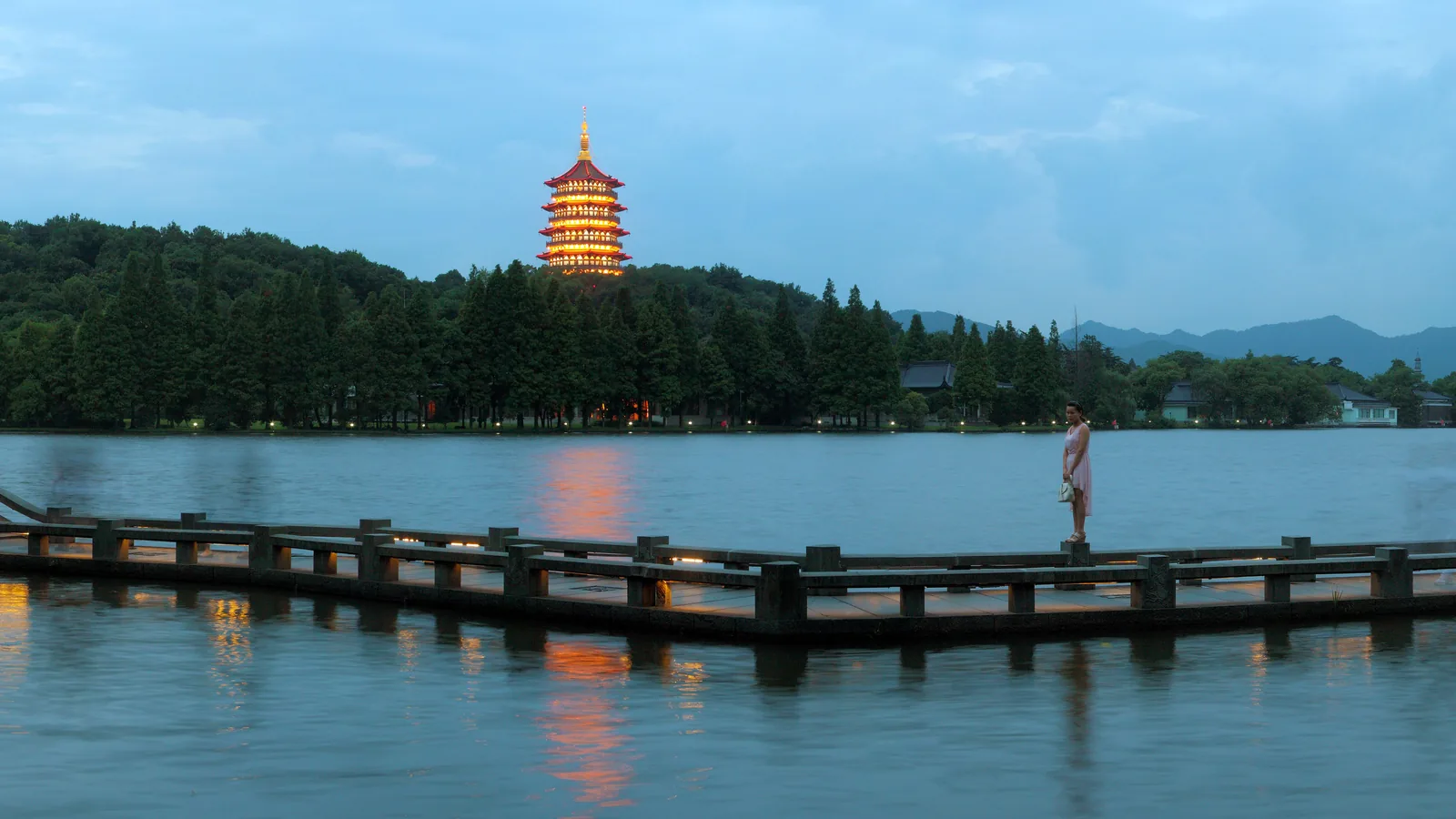
If you would rather be on the water, the large ferries out to the islands run about 55 to 70 yuan including the island landing, hand-rowed boats go for roughly 150 to 180 yuan an hour hired by the boat rather than per head, and the hop-on hop-off lake bus costs a few yuan a stop. Shared bikes are the cheapest way to cover ground at around 1.5 yuan per half hour.
The framing device locals use is the Ten Scenes of West Lake, a list fixed in the Southern Song and later inscribed by the Kangxi Emperor: Spring Dawn at the Su Causeway, Lingering Snow on the Broken Bridge, Leifeng Pagoda in Evening Glow, Three Pools Mirroring the Moon, and six more. They are as much about season and hour as location. Three Pools Mirroring the Moon is the three small stone pagodas standing about two meters clear of the water off Xiaoying Island. Look at the back of a one yuan note and you are looking at it.
#2: See a live performance on the water
Two shows are worth the ticket, and one of them is famous under two different names.
- Impression West Lake, now billed as Enduring Memories of Hangzhou. Zhang Yimou’s open-air night show is performed on West Lake itself, on a stage set about three centimeters below the water surface, so the dancers appear to be walking on the lake. The current production was reworked for the 2016 G20 Hangzhou Summit and returned to public performance in May 2017 under the Enduring Memories billing, which is why you will see both titles sold side by side. It runs 55 minutes, roughly March to November, nightly at 19:40 with a second later show added on peak dates. Tickets run from around 360 yuan up to 960 for premium seating. Seasons get reshuffled, so confirm the current run before you build an evening around it.
- The Romance of the Song Dynasty. Staged at the Songcheng theme park in Xihu District, this one runs through the Legend of the White Snake, the Butterfly Lovers and General Yue Fei’s defense against the Jin. It is about an hour, with an afternoon and an evening showing most days and extra performances in peak season, and the standard ticket of around 300 yuan covers the park as well as the show.
If you would rather spend nothing, the musical fountain at Hubin Park 3 on the eastern shore performs free most evenings for about fifteen minutes at a time. Posted times shift with the season, so check on the day.
#3: Take a day trip to the water towns
Worth being precise about this, because plenty of guides are not: the famous canal towns are not in Hangzhou. Wuzhen sits 86 kilometers away in Tongxiang, a county-level city under Jiaxing, and buses run from the Hangzhoucheng bus center near Hangzhou Railway Station every half hour, taking about an hour and a half. Xitang is further out at 110 kilometers, in Jiashan County, roughly an hour and forty minutes by direct tourist bus from Jiubao station. Both are beautiful, both are day trips, and both are worst at weekends.
Hangzhou does have its own canal quarter, and it is the better-kept secret. The Grand Canal ends here: the Beijing to Hangzhou Grand Canal was inscribed by UNESCO in 2014 across 27 sections and 58 sites, which gives the city two World Heritage listings. Its southern landmark is Gongchen Bridge, built in 1631 and still the highest and longest ancient stone arch bridge in Hangzhou. The Qiaoxi Historic Block beside it holds a row of free specialist museums, including ones devoted to umbrellas and to knives, scissors and swords.
#4: Walk Qinghefang, the old Hangzhou street
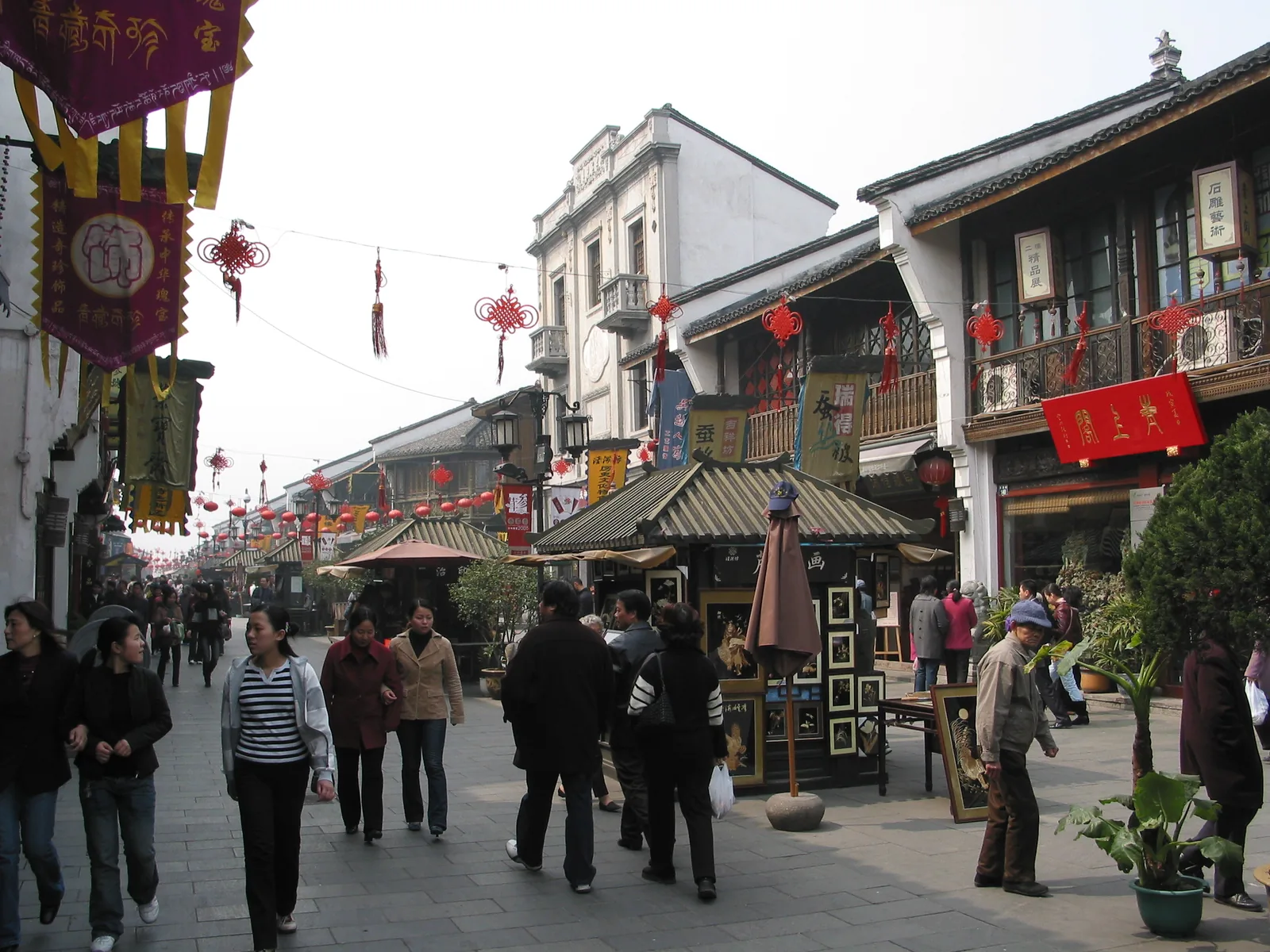
Qinghefang Old Street is the best-preserved stretch of the old city and the easiest place to spend an afternoon on foot. Sightseeing, eating and shopping all happen on the same few hundred meters, the buildings are genuinely old rather than reconstructed, and the shops range from serious tea and silk merchants to tourist tat. It gets crowded in peak season. Go early or go late.
#5: See the other Hangzhou, the one that runs on an app
Hangzhou is where Alibaba is headquartered, and the city wears it. This is about as cashless a place as exists anywhere: nearly every counter displays a payment code, and cash makes a shopkeeper hunt for change they may not have. Since July 2023 both Alipay and WeChat Pay have accepted Visa and Mastercard, so foreign cards now work inside the apps the city runs on. Set them up before you fly. Our guide on how to use WeChat Pay and Alipay in China covers the process.
#6: Learn what Longjing tea actually is
Longjing comes from these hills, and the tea villages are a 20 to 30 minute taxi ride from the lake, or buses 27 and 87 to Longjing Village. The two villages worth your time are Longjing Village itself and Meijiawu, which is bigger and more spread out.
The harvest runs March to May. The grade everyone talks about is pre-Qingming (mingqian), picked from mid-March to 4 April, slow-grown tender buds from cold early spring; pre-Guyu (yuqian) follows from roughly 5 to 20 April. Core-area pre-Qingming leaf sells for 3,000 to 8,000 yuan and up per 500 grams, which tells you everything about the cheap “first pick” being pressed on tourists. Drink rather than impulse-buy, agree the price before anyone pours, and look for the West Lake Longjing geographic-indication mark on any packet you do take home. A cup in a village family teahouse runs 20 to 30 yuan.
The China National Tea Museum is free and has two separate pavilions, Shuangfeng on Longjing Road, open since 1991, and the newer Longjing pavilion at Wengjiashan, open since 2015. Both sit inland in the tea hills rather than on the lake shore. Between them they cover how the leaf is grown, picked, pan-fired and brewed, and they connect straight to the wider Chinese tea culture the city is built on.
#7: Visit the silk and Chinese medicine museums
The China National Silk Museum is the first national silk museum in China and the largest silk museum in the world. It opened in 1992 on the southern bank of West Lake, covers around five hectares, and has been free to enter since 2004. The halls run from the origins of sericulture through the main silk types, the production process, the Silk Road and silk’s role in the old social order. Hours are 09:00 to 17:00 Tuesday to Sunday, with a late noon opening on Mondays.
The Hu Qing Yu Tang Museum of Traditional Chinese Medicine is the only state-level Chinese medicine museum in the country, and it is still a working pharmacy. It was founded in 1874 by Hu Xueyan, the late-Qing merchant, and it sits inside the Qinghefang block, so you can pair it with #4 in one walk. There is an exhibition hall, a preparation hall where staff demonstrate the old compounding techniques, a functioning clinic, a medicinal-diet restaurant and a dispensary.
#8: Explore the Buddhist heritage
Hangzhou’s Buddhist landscape is not incidental, it is a building program. The Wuyue kingdom, which ruled this coast in the tenth century, poured money into temples and pagodas: Liuhe Pagoda went up in 970, Leifeng Pagoda in 975, and Lingyin Temple was restored and expanded under the same patronage.
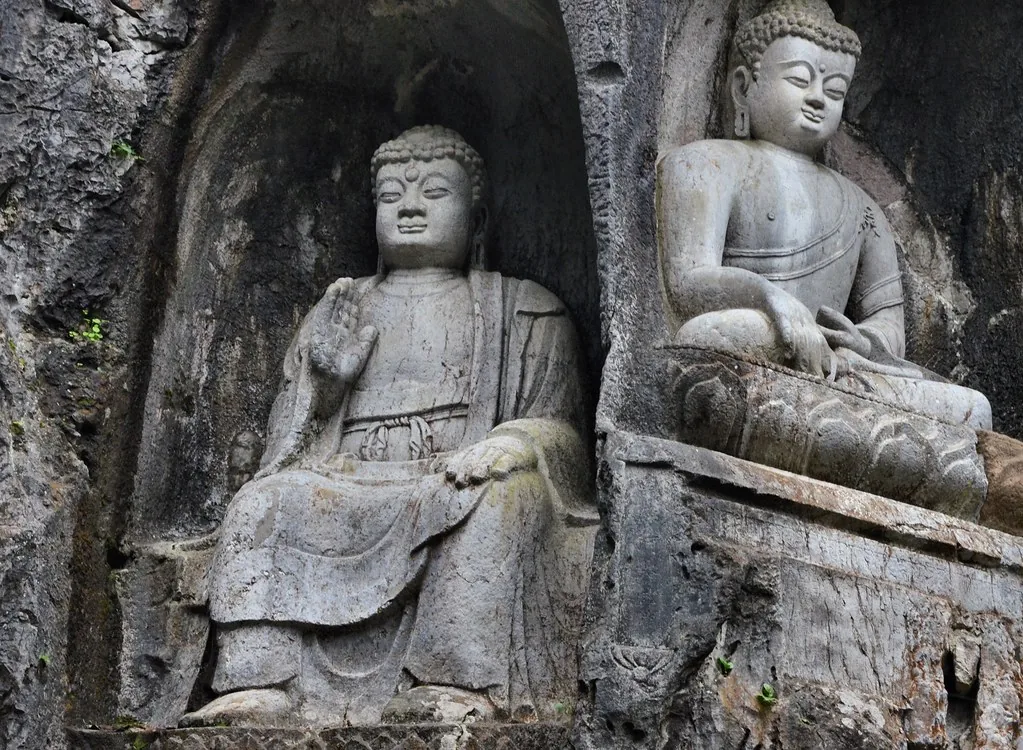
The single most remarkable survival is Feilai Feng, the limestone hill facing Lingyin Temple. More than 470 Buddhist statues and reliefs are cut into its rock faces and grottoes across 153 shrines, around 340 of them still in good condition, most carved between the tenth and fourteenth centuries under the Northern Song and the Yuan. It is the largest group of ancient rock carvings in Jiangnan. They are not behind glass. You walk the paths and the Buddhas are there in the stone beside you, some the size of a fist, one laughing Maitreya large enough to dominate a whole cliff face. Go early. By ten in the morning the tour groups own it.
Liuhe Pagoda, the Six Harmonies Pagoda, stands on Yuelun Hill above the Qiantang River south of the lake. The Wuyue ruler built it in 970 for two reasons at once: to subdue the river’s tidal bore, which was destroying dikes and farmland, and to work as a navigation beacon at night. It is roughly 60 meters, octagonal, thirteen tiers from the outside, and one of the best-preserved brick-and-timber pagodas in China. Entry is about 20 yuan with another 10 to climb it, and the gate closes at 17:30.
#9: Eat what Hangzhou is known for
Hangzhou cuisine is one of China’s named regional styles and it is the opposite of Sichuan: light, sweet-savory, freshwater-based, more interested in texture and the quality of a single ingredient than in heat. Five dishes carry the city.
- West Lake fish in vinegar gravy (xihu cuyu) is the signature and the most divisive. Grass carp, usually under a kilogram so the flesh stays tender, poached and dressed in a sauce of vinegar, yellow wine, soy, sugar and starch. Ordered badly it is muddy and sharp. Ordered at a serious restaurant it is the reason the dish is famous.
- Dongpo pork is pork belly braised slowly with Huadiao wine, ginger, spring onion, rock sugar and soy until it is rich without being greasy. It is named for Su Dongpo, the same Song poet-official who built the causeway you walked in #1.
- Longjing shrimp is small river shrimp stir-fried with Longjing leaves and the liquor from the brew, which puts the city’s two best products in one bowl.
- Beggar’s chicken is a whole chicken packed in clay and baked, cracked open at the table.
- Pian er chuan is the everyday noodle: pickled mustard greens, bamboo shoots and lean pork over noodles, eaten standing up at lunch.
For where to eat them, the old restaurant houses around Hubin and Qinghefang serve the full banquet versions at banquet prices, while the noodle shops and small places a street back from the lake do the same regional cooking for a fraction of it. If you want a sense of what a meal should cost before you sit down, see how much a meal costs in China.
#10: Climb Baoshi Hill to Baochu Pagoda
Every other guide gets this wrong: Baochu Pagoda is solid. It has no internal staircase and you cannot climb it. The view is the walk. Baoshi Hill, Precious Stone Hill, rises off the northern shore and the paths up it are free, open and well maintained, running through woodland past viewpoints, a temple and the pagoda itself. From the base of the pagoda you get the whole lake laid out below with the city behind it. Late afternoon into sunset is the hour to do it.
#11: Visit Leifeng Pagoda
On Sunset Hill on the southern side of the lake. The original was built in 975 by King Qian Chu of Wuyue and stood until 25 September 1924, when decades of brick theft and undermining brought it down. The replacement opened on 25 October 2002: five stories, eight sides, a 1,400-tonne steel frame with 200 tonnes of copper on it, and escalators and lifts inside, so the climb is no climb at all. The excavated ruins of the original pagoda are preserved at the base underneath the new structure and you go down to see them. Entry is around 40 yuan, and the top floor gives the best single panorama of the whole lake. Leifeng Pagoda in Evening Glow is one of the Ten Scenes for a reason.
#12: Visit Lingyin Temple, and book it first
Lingyin Temple is one of the oldest and largest Buddhist temples in China, and it is where you will see locals rather than tourists lighting incense and praying. The ticketing changed recently and getting it wrong will cost you the day.
Since 1 December 2025 the Feilai Feng scenic area is free, replacing the old 45 yuan ticket. In exchange it now runs on a timed reservation, booked at least one day in advance through the Lingyin Feilai Feng mini-program on WeChat or Alipay. The app will not sell you a slot for the same day. If the day’s quota has not filled, you can still register on the spot with your passport, but that is a gamble rather than a plan. Daily caps run 35,000 on weekdays, 50,000 at weekends and 65,000 on public holidays. The temple itself still charges about 30 yuan, a donation ticket bought at the gate on the day, not online, so ignore anyone selling you that part in advance. Open 07:30 to 17:30 with last entry at 17:00, and reservation slots split into a morning and an afternoon window.
Getting there from the lake is 20 to 25 minutes by taxi or DiDi, or Metro Line 3 to Huanglong Sports Center and the Lingyin bus from there.
How to get to Hangzhou from Shanghai
By high-speed rail, and it is barely a journey. Trains run Shanghai Hongqiao to Hangzhou East in about 45 to 60 minutes on most services, with the fastest scheduled runs at around 42 minutes and slower multi-stop trains taking up to about 75. There are well over 300 departures a day, the first before 05:00 and the last close to 23:00, so there is no real need to book a specific one far ahead outside national holidays.
Hangzhou East is the main station and it is on the metro, so you are at the lake within half an hour of stepping off the train. If you are flying in instead, Hangzhou Xiaoshan International is the airport.
Getting around once you are there
The metro does most of the work: thirteen lines and around 270 stations, with most of the network running from about 06:00 to somewhere between 22:30 and 23:00. Line 19 is the one to know. It is the airport express, linking Xiaoshan International to both Hangzhou East and Hangzhou West railway stations, end to end in about an hour and under 10 yuan either way, and the trains have luggage racks, which is unusual and welcome.
Around the lake itself, walk or take a shared bike. Traffic on the lakeside roads is slow and the scenery is the point. For the wider picture on trains, metros and taxis, see our guide to getting around in China.
The best time to visit Hangzhou
Spring, March to May, and autumn, September to November. Those are the two windows and everything else is a compromise.
Late June into early July is the plum rain season, meiyu, and it rains persistently. Summer is hot and humid, but it is also when the lotus is in full bloom across the lake, which is one of the Ten Scenes and worth sweating for. Autumn is the strongest season outright: osmanthus, the city flower, comes out from late September and the whole city smells of it, with peak bloom usually after 20 October. Manjuelong, in the hills southwest of the lake, is the main venue for the West Lake Osmanthus Festival, which runs from mid-September into early November, and Hupao Road is the other classic fragrance route.
One thing to time deliberately if you can: the Qiantang River tidal bore, one of the largest in the world, peaks on the eighteenth day of the eighth lunar month, usually around the Mid-Autumn Festival. The best viewing is at Yanguan in Haining, at the Haitang, Babao or Laoyanchang points. Tides typically arrive somewhere between 11:45 and 14:15, but the real time shifts with weather and water level, so go by the notices posted on the day.
Winter is quiet and cold, and if it snows you get Lingering Snow on the Broken Bridge, which most Chinese visitors never manage to see.
Where to stay in Hangzhou
Hubin and Longxiangqiao, on the eastern shore of the lake, is the default and the right answer for a first visit. You can walk to the water, the metro is there, and the restaurants and malls are on your doorstep. The trade-off is crowds and price, both at their worst at weekends and over national holidays.
Wulin Square, just north of the lake, is Hangzhou’s main commercial district and the sensible alternative. Metro Lines 1 and 3 run through it, the lake is about ten minutes away by metro and Hangzhou East station is a direct ride, and rooms cost noticeably less than lakefront equivalents. It is less atmospheric. It is also far easier to book late.
More things to do in Hangzhou if you have a third day
Two days covers the lake, a temple and the tea hills. A third opens up the parts of the city most visitors never reach.
Xixi National Wetland Park is 80 yuan at the gate, with boats charged separately at 60 yuan for an electric boat and 100 for hand-rowed. A combined entry and boat ticket is 140, or 115 booked online. Two metro stations serve it: South Xixi Wetland on Line 3 and North Xixi Wetland on Line 19, each a short walk from the gate it is named for.
The Grand Canal at Gongchen Bridge is the other one, best walked in the evening when the bridge and the old wharf buildings are lit. And if you are heading onward rather than back to Shanghai, Suzhou is under an hour away by train and makes the obvious pairing.
How long Hangzhou is actually worth
Two days is the honest answer for most people, three if you want to eat properly and walk the canal. Beyond that you are into the hills, the wetlands and the outlying water towns, which reward the time if you have it. Book Lingyin before you arrive, keep the afternoons loose, and give yourself an unhurried day here rather than a checklist. This is a city built for slow looking.
Quick answers.
Is one day in Hangzhou enough?
Do you need to book Lingyin Temple in advance?
How far is Hangzhou from Shanghai?
Your dates. My quote.
Twelve hours.
Send your cities, dates and product list. You'll get a fixed written quote, no obligation, no deposit to ask.
superinterpreter · selina@mychinainterpreter.com · Xiamen, China · UTC+8