The 12 Best Things to do in Suzhou on a Weekend Break
Suzhou sits under half an hour from Shanghai by high-speed train and holds nine UNESCO-listed classical gardens, most of them in or around the old city. Here are the 12 best things to do in Suzhou on a weekend, plus how to get there and where to stay.
 Selina Chen 陈丽明 EN ⇄ 中文 · Travel guide
Suzhou has been a byword for refinement in China for a thousand years, and the old saying pairs it with Hangzhou as heaven on earth. It is one of China’s ancient capitals, the city of silk and of the classical garden, and it is close enough to Shanghai that most visitors arrive on a morning train and leave on an evening one. That is a mistake. Two days is the right length, and this is how to spend them.
#1: Book the Humble Administrator’s Garden before you go
This is the one garden everyone comes for, and the one most people fail to get into because they turned up at the gate. The Humble Administrator’s Garden was laid out from 1513 by Wang Xianchen, a retired Ming official, and at 5.2 hectares it is the largest garden in Suzhou. It splits into three parts: a looser eastern section built around a lawn and pond, the central garden around its main pond and three islands, and a smaller, water-heavy western garden. The central section is the masterpiece. Walk it slowly and watch how every window and moon gate frames a different view.
There are no ticket sales on site. You book a dated, real-name ticket through the Suzhou Gardens Tourism channel on WeChat, up to about a week ahead, and foreigners book with a passport number. Peak-season weekends sell out days in advance. Bring the physical passport you booked with: that is what the gate checks, and a photo of it on your phone will not do. Tickets are 80 yuan in peak season (broadly April to October) and 70 yuan off-peak, with half price for students and seniors aged 60 to 69, and free entry over 70.
Normal hours are 7:30 to 17:30 from March to mid-November and 7:30 to 17:00 in winter. In summer 2026 the garden moved its opening forward to 6:45 between 19 June and 7 October, the first change to its opening time in decades. Go at opening either way. By 10:00 the central garden is shoulder to shoulder. The garden has also added an evening program, Zhuozheng Wenya, with lighting and Kunqu performance; English-guided tickets were 268 yuan in 2026.
#2: See the smaller gardens, starting with the Master of the Nets
The Humble Administrator’s Garden is the biggest, not the best, and many garden people would give that title to one of the small ones. Suzhou has dozens of surviving classical gardens built between the 11th and 19th centuries, and nine are inscribed together on the UNESCO World Heritage List as the Classical Gardens of Suzhou: four in 1997 and five more in 2000. Pick two or three of these:
- Master of the Nets Garden. About half a hectare, and the proof that size has nothing to do with it. It was first laid out in 1140, and its Late Spring Cottage courtyard was copied as the Ming Hall at the Metropolitan Museum of Art in New York. From spring to mid-November it runs a night garden, with Kunqu, pingtan and traditional music performed in different halls as you walk through. It closes for winter.
- Lingering Garden. A Ming garden known for its long covered corridors and its tall Taihu rocks, the best of which stands in its own courtyard. Tickets are 55 yuan in peak season and 45 off-peak.
- Canglang Pavilion. Dating from the Northern Song, it predates every other garden on this list, and it borrows the canal outside its walls as part of the view.
- Lion Grove Garden. A rockery maze of eroded limestone, a five-minute walk from the Humble Administrator’s Garden, which makes it the easy second garden of the morning.
Booking works the same way as #1, through the Suzhou Gardens Tourism channel with your passport. All of these are within reach on a guided Suzhou day tour if you would rather someone else handled the reservations.
#3: Walk Pingjiang Road
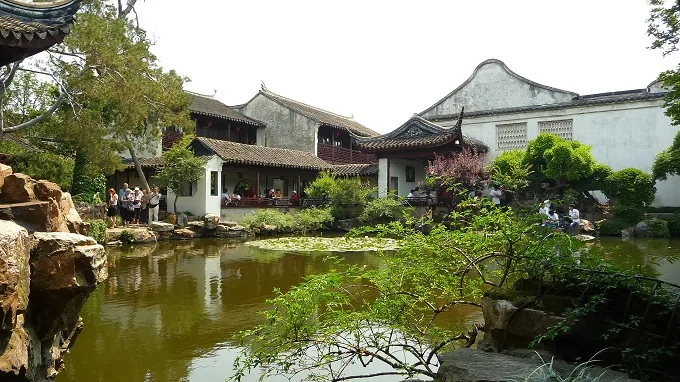
Pingjiang Road is 1.6 kilometers of canal-side street in the old city, and it already appears on the Pingjiang Tu, a city map carved in stone in 1229, under the city’s Song dynasty name. The street plan and the canal beside it have barely moved since. Whitewashed houses back straight onto the water, stone bridges cross it every few hundred meters, and the side lanes run off at right angles exactly as they do on the map. The Couple’s Retreat Garden, another of the UNESCO nine, sits at the eastern edge of the district.
The road itself is a tourist strip now, all teahouses, snack shops and souvenir stalls. Walk it early in the morning or after dark, and step into the side lanes, which are still residential. It sits a short walk from the Humble Administrator’s Garden and the Suzhou Museum, so the three make one easy day.
#4: Visit the Suzhou Museum
The museum is worth the trip for the building alone. I.M. Pei designed it in his late eighties; it opened in 2006 next door to the Humble Administrator’s Garden, in the city his family came from. Gray-and-white geometry, a water garden of sliced stone set against a white wall, and natural light everywhere. The collection covers Ming and Qing painting and calligraphy, ceramics and crafts, and connects to the mansion of Li Xiucheng, the Loyal Prince of the Taiping Heavenly Kingdom, who made it his residence in the 1860s.
Entry is free, but the main museum runs on timed reservations booked online or through its WeChat mini-program, opening seven days ahead, and foreign visitors book with a passport. It is open 9:00 to 17:00 with last entry at 16:00 and closes on Mondays, except public holidays. There is also a newer West Museum in the Suzhou New District, out toward the west of the city.
#5: Hear Kunqu or pingtan where they come from
Kunqu is the oldest surviving form of Chinese opera, around 600 years old, and it grew up in Kunshan, now part of Suzhou. UNESCO proclaimed it a Masterpiece of the Oral and Intangible Heritage of Humanity in 2001. It is slow, sung in a Suzhou-inflected literary Chinese, and it is the ancestor that Peking opera borrowed from. Pingtan is the local storytelling and ballad tradition: one or two performers with a three-string sanxian and a pipa, singing and talking in Suzhou dialect.
The best place to start is the China Kunqu Museum, housed in the Quanjin Guild Hall in a lane off Pingjiang Road, which keeps two antique stages and puts on regular performances. The Suzhou Pingtan Museum is in the same quarter. You will not follow the words, and nobody expects you to. The Master of the Nets night garden in #2 is the gentlest introduction to both.
#6: Walk Shantang Street to Tiger Hill
Shantang Street was built in 825 by the poet Bai Juyi when he governed Suzhou, on an embankment piled up from the mud dredged out of the canal beside it. It runs about 3.8 kilometers from Changmen Gate in the northwest of the old city to Tiger Hill, which is why it is still called Seven Li Shantang. The eastern end, near Changmen, is the restored and busy part, with lantern-lit shops and boats running along the canal at night. Keep walking west and it thins out into an ordinary street, and then you are at Tiger Hill.
#7: Climb Tiger Hill
Tiger Hill is where Suzhou’s legends start. King Helü of Wu, who died in 496 BC, is said to be buried beneath the Sword Pool, a narrow cleft in the rock that supposedly hides his tomb and the swords buried with him. The tomb has never been opened.
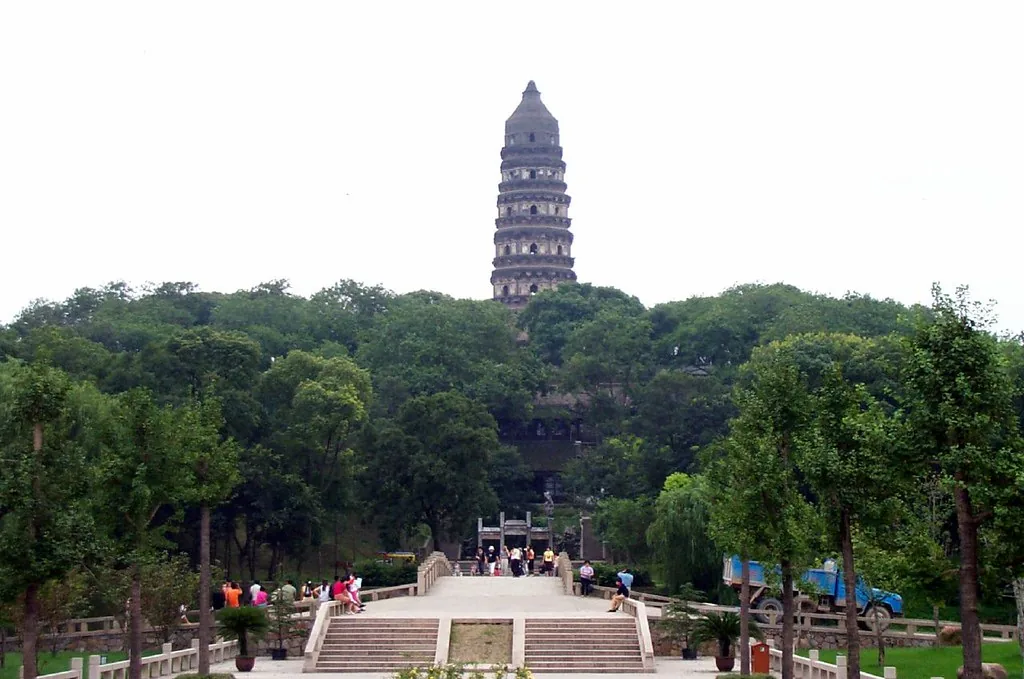
The hill is topped by the Yunyan Temple Pagoda, begun in 959 and finished in 961, more than two centuries before work started on the Leaning Tower of Pisa. It leans visibly to the northwest, which is why Chinese guides call it the leaning tower of China. On the east side of the hill, the Wanjing Mountain Villa holds the city’s collection of Suzhou-style penjing, the Chinese ancestor of bonsai, at its best in autumn. Tickets are 80 yuan in peak season and 60 off-peak.
#8: Take a boat through Zhouzhuang
Zhouzhuang markets itself as the first water town of China, and it has earned the slogan more than most. It is in Kunshan, on Suzhou’s eastern edge toward Shanghai, and its core is a cluster of Ming and Qing houses, stone bridges and canals small enough that hand-rowed boats are the best way to see it. The Twin Bridges, two stone bridges meeting at a right angle, are its signature view.
The ticket is 100 yuan. It is also crowded, so arrive before 8:00, when the lanes are still quiet and entry to the streets is free, or stay for the evening after the tour groups have left.
#9: Spend a quieter afternoon in Tongli
If Zhouzhuang is the famous one, Tongli is the better one for many travelers: a working town as well as an attraction, in Wujiang district south of the city, with canals splitting it into islands joined by dozens of bridges. Its centerpiece is the Retreat and Reflection Garden, built in the 1880s by an official dismissed from his post, and one of the nine UNESCO-listed gardens, so you get a water town and a World Heritage garden on one ticket. Entry is 100 yuan, and arriving before 8:00 again buys you the streets free and empty.
#10: Learn how silk is actually made
Suzhou has been a silk city since long before the Song, and the Suzhou Silk Museum on Renmin Road walks through the whole process: silkworms, cocoons, reeling, and the looms that turn thread into brocade, with weavers working the old machines. It opened in 1991, is free, open 9:00 to 17:00 and closed on Mondays.
The old Suzhou First Silk Factory, founded in 1926 as one of the city’s most important reeling mills, has been converted into a creative park of design studios, shops and event space. It tells you more about what happened to Chinese silk manufacturing than about how silk is made. If you want to buy silk, buy it in a shop you picked yourself, not in the factory showrooms that tour buses stop at.
#11: Spend an evening on Jinji Lake
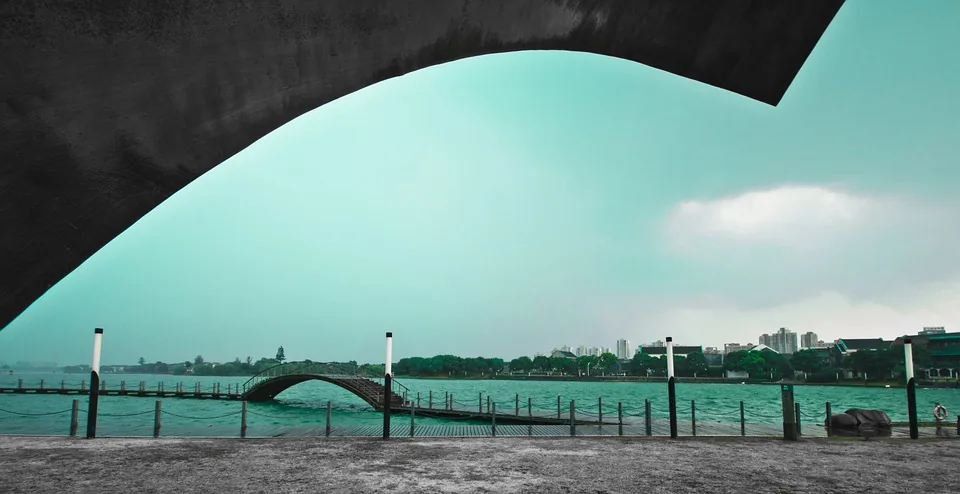
Jinji Lake is the modern Suzhou: the center of Suzhou Industrial Park, east of the old city, ringed by glass towers, hotels and a waterfront promenade. The view across the water to the Gate to the East, the twin-legged skyscraper locals call the trousers, is the city’s postcard of the present. Li Gong Di, a causeway across the lake lined with restaurants and bars, is where the international crowd eats, and the lakeside parks are good for an evening walk. It is a completely different city from the gardens, and worth seeing for that reason alone.
#12: Eat Suzhou food
Suzhou cooking is sweet, delicate and seasonal, about as far from Sichuan as Chinese food gets. The dish to order is squirrel-shaped mandarin fish: a whole fish scored, deep-fried until it fans out, and served under a sweet-and-sour sauce. Breakfast is a bowl of Suzhou-style noodles in clear broth, with the toppings ordered separately. In autumn, roughly September to November, the city goes quiet for hairy crabs from Yangcheng Lake, its most famous food export. Songhelou on Guanqian Street is the old-name restaurant for the classics; for noodles, follow the queues of locals in the old city.
Getting from Shanghai to Suzhou
The train is the answer. High-speed trains run from Shanghai Hongqiao and Shanghai Railway Station to Suzhou all day, well over a hundred departures, and the fastest take under half an hour. Most run between 25 and 40 minutes. Second class costs roughly 45 yuan at the published fare. Book on the 12306 app or a booking platform with your passport, and pick the arrival station by where you are going:
- Suzhou Station is just north of the old city, the right stop for the gardens, Pingjiang Road and the museum.
- Suzhou North is on the Beijing-Shanghai high-speed line, further out, with a metro ride into the center.
- Suzhou Industrial Park Station suits Jinji Lake and the business district.
If you would rather not deal with tickets and garden reservations at all, a private Shanghai tour can run a Suzhou day out of the city with the transport and bookings handled.
Getting around Suzhou
The Suzhou Metro had nine lines in operation at the end of 2024, with more under construction, and it reaches most of what is on this list. Line 11 even meets Shanghai Metro Line 11 at Huaqiao, so you can technically ride the subway between the two cities, though it is far slower than the train. Inside the old city, distances are short enough to walk or ride a shared bike, and taxis and ride-hailing apps are cheap for the trips out to Tiger Hill. Zhouzhuang and Tongli are easiest by car or tour bus.
When to visit Suzhou
Spring and autumn. April and May bring the gardens into flower, and October and November bring clear skies, osmanthus and hairy crab season. Summer is hot and humid, and the plum rain season, roughly mid-June to early July, makes it wet as well, though the lotus in the Humble Administrator’s Garden peaks then. Winter is cold, gray and quiet, which has its own appeal in a garden. Avoid the national holidays, especially the first week of October, when the gardens and water towns are at their worst.
Where to stay in Suzhou
Stay in the old city if you are here for the gardens. The lanes around Pingjiang Road and Guanqian Street put you within walking distance of most of #1 to #5, and there are boutique hotels in converted courtyard houses as well as the usual chains. Stay around Jinji Lake if you want the big international hotels, a skyline view, and easy access to the business district, which is where most business travelers in Suzhou end up anyway. The metro links the two in about half an hour.
How to plan a weekend of things to do in Suzhou
Day one: the Humble Administrator’s Garden at opening, Lion Grove next door, the Suzhou Museum after lunch, then Pingjiang Road at dusk and the Master of the Nets night garden if it is in season. Day two: Tiger Hill in the morning, Shantang Street back toward the old city, and Jinji Lake for dinner. Add a third day and spend it in Tongli or Zhouzhuang. Suzhou repays slowness more than any city in China, and anyone who sees it in a single day from Shanghai has seen the gardens, not the city.
Quick answers.
Do you need to book the Suzhou gardens in advance?
Is Suzhou worth a day trip from Shanghai?
Which Suzhou railway station should I use?
Your dates. My quote.
Twelve hours.
Send your cities, dates and product list. You'll get a fixed written quote, no obligation, no deposit to ask.
superinterpreter · selina@mychinainterpreter.com · Xiamen, China · UTC+8