Shanghai Airlines Review - Flight Ratings
Routes Hongqiao (SHA) hub feeding domestic trunk routes plus short-haul regional Asia; part of China Eastern / SkyTeam since the 2009 merger.
 Selina Chen 陈丽明 EN ⇄ 中文 · Frequent flyer · Trade & sourcing
 - Comfortable seats and good, generous catering
- Friendly crew and reliable on-time departures
- Affordable fares for the comfort you get
- Weak or no in-flight entertainment; screens small and content mostly in Chinese
- Domestic/regional business is a recliner, not a lie-flat; the flat suite is 787-9 only
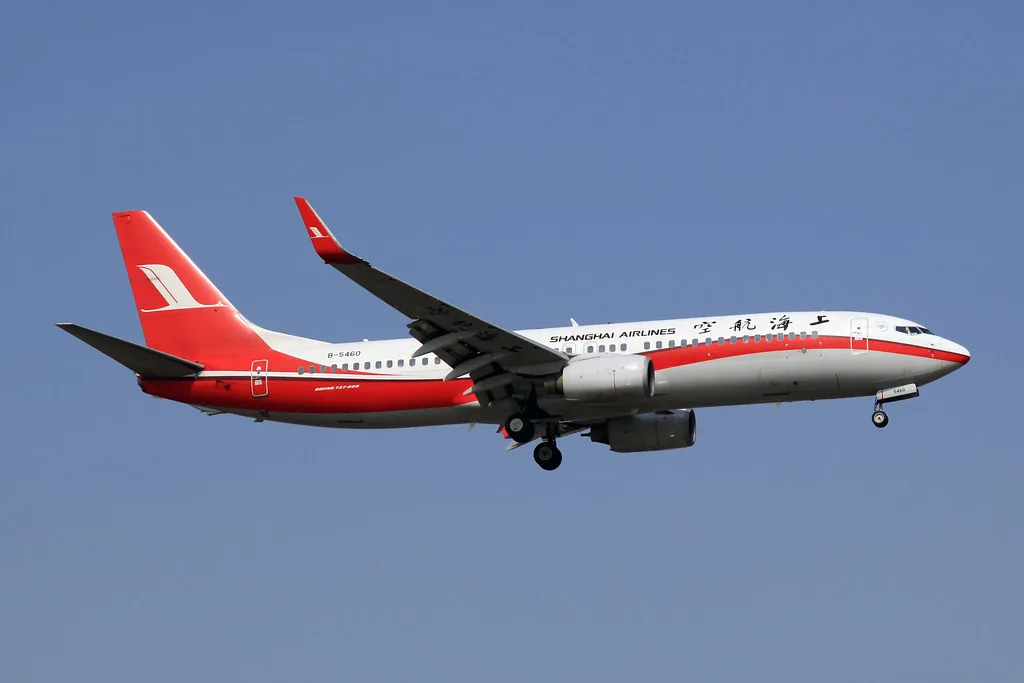
Our personal Shanghai Airlines review
Planning a trip and want to know if this is a good airline to fly with? Here we put together a Shanghai Airlines review from our own experience so you get a better idea of what to expect. Founded in 1985, Shanghai Airlines is one of China’s oldest carriers. It was started by the Shanghai provincial government together with local businesses to function as a domestic airline linking China’s commercial capital to the rest of the country. Shanghai Airlines historically concentrated operations at Shanghai’s main domestic airport, while its rival China Eastern worked out of Shanghai Pudong International, the city’s primary long-haul airport.
Shanghai Airlines in-flight classes
What you get depends heavily on the aircraft, and Shanghai Airlines flies two very different products. The domestic and regional network runs on Boeing 737s, where the cabin is a straightforward two-class layout. The long-haul work belongs to the Boeing 787-9, and that is a genuinely modern aircraft with a proper premium cabin. Book the wrong assumption and you will be disappointed; book with your eyes open and the 787 in particular punches above its fare.
Economy class
On the 737 domestic fleet, economy is a standard six-abreast cabin. Seat pitch is tight but acceptable for the two- and three-hour hops it flies, the seats are clean and in good repair, and a hot meal or snack plus complimentary drinks arrive depending on how long you are in the air. In-flight entertainment is the weak spot: most narrowbodies have small seat-back screens or none at all, and what content there is runs mostly in Chinese with English subtitles that are hard to read.
Long-haul economy on the 787-9 is a different animal. The cabin is quieter, the pressurization and humidity are easier on a long flight, and every seat has a personal screen with a reasonable film library. Legroom is average for the class rather than generous, so a tall traveler on a ten-hour sector will feel it, but the seat is comfortable and the crew keep the drinks moving. For an economy ticket on a Chinese carrier, it is a solid, unfussy long-haul product.
Business class
The 787-9 is where the airline actually spends money. That aircraft carries 285 seats, four of them in a tiny first-class cabin at the nose and 26 in business, and business is a staggered, forward-facing suite with a lie-flat bed, direct aisle access, and a privacy door at each pod. Every business seat has personal in-flight entertainment and proper table space for working or eating. The seat itself is well regarded; the honest caveats are a small footwell that a taller passenger will find cramped once flat, and doors that, at the time of the last cabin refresh, the regulator had not yet cleared crews to close in flight, so treat them as decorative for now.
Do not confuse this with the “business” seat on the 737 domestic fleet. On the narrowbodies, business is a wider recliner at the front of the cabin with a bit more pitch and priority service, not a flat bed. It is a comfortable way to cross China, but it is a domestic recliner, so keep expectations set to the aircraft you are actually booked on.
Food and drinks onboard
Catering is one of the reasons the airline scores as well as it does. Even on a short domestic sector you get more than a token snack: a hot box meal or a filled roll with fruit, plus a full drinks run including tea, coffee and soft drinks. On the 787-9 long-haul routes the meal service steps up to a multi-course tray in economy, with a Chinese main and a Western alternative, and business passengers get a proper plated meal with a starter, a hot main, dessert and alcoholic drinks. The coffee is airline coffee and no better than it needs to be, but the food itself is generous and consistently well rated for the fare. If you have a dietary requirement, order the special meal at booking rather than hoping onboard, as the English side of the operation is where things get missed.
Some of the pros
The seats are comfortable and the food is genuinely good. The staff are friendly and welcoming, so you won’t have much to complain about onboard. Service is unrivalled for the price, even on a short hop you’ll get a snack, and the crew is ready to help whenever you need it. Departures are punctual in most cases, so you tend to arrive on schedule.
What are the cons
If you care about in-flight entertainment, this may be the wrong airline on the narrowbodies. Most 737s have small screens or none, and the content is in Chinese with English subtitles that can be hard to read. Business on the domestic and regional fleet is a let-down too: on a five-hour sector you get a standard recliner rather than an angle-flat or lie-flat seat, and the cutlery is a mix of stainless steel and plastic. The lie-flat suite described above is a 787-9 perk, so it is the aircraft, not the ticket class, that decides what you actually get.
The airport
Shanghai Hongqiao International Airport is the primary domestic airport serving the airline, with limited international flights. It is a hub for Shanghai Airlines, China Eastern, Spring Airlines and Juneyao Airlines, and comprises two runways with a capacity of nearly 40 million passengers a year. Other carriers using it include Air China, China Southern, Air Macau, Hebei Airlines, EVA Air and Shandong Airlines.
Aircraft used in the fleet
Shanghai Airlines flies an all-Boeing fleet, unusual among the big Chinese groups, most of which run mixed Boeing and Airbus lines. Around 90 aircraft are in service, at an average age of roughly ten years:
- Boeing 737-700 (a handful, oldest of the narrowbodies)
- Boeing 737-800 (the backbone, close to sixty aircraft, on domestic trunk and regional Asia routes)
- Boeing 737 MAX 8 (the newest narrowbodies, back in service after the global grounding)
- Boeing 787-9 Dreamliner (ten aircraft, the long-haul and premium fleet)
The old 767s, A330s and regional jets that used to show up in fleet lists are long gone. The one thing on the horizon is Chinese-built metal: the airline has five Comac C909 regional jets on order, the aircraft formerly branded ARJ21, but none had entered service by 2026. So despite the group’s public interest in flying domestic types, what you actually board today is Boeing, narrowbody at home and the 787-9 abroad.
History and alliance
Shanghai Airlines began short-haul international flights in 1997, connecting Shanghai to nearby Asian destinations. It listed on the Shanghai Stock Exchange in 2002 and launched a cargo division in 2006, then joined Star Alliance in 2007. In 2009 it merged with its main competitor, China Eastern, switching alliance from Star Alliance to SkyTeam, delisting from the exchange, and folding its cargo operations into China Cargo Airlines.
Is Shanghai Airlines worth it?
For the money, yes, with one condition: fly it for what it is. This is a solid, mid-tier Chinese carrier that gets the fundamentals right. The aircraft are modern and well kept, the crews are friendly and punctual, and the catering is more generous than the fare suggests. Where it falls short is the polish that costs money to fix, namely patchy in-flight entertainment on the narrowbodies and an English-language operation that still drops the occasional ball. None of that matters much on a two-hour domestic hop, and on the 787-9 the premium cabin is good enough that the price starts to look like a genuine bargain against the flag carriers.
The way to read it is by aircraft, not by brand. If your itinerary puts you on a 737 around China, expect a clean, competent short-haul flight and pack your own entertainment. If it puts you on a 787-9 to or from a long-haul destination, you are getting a lie-flat business suite and a real long-haul economy product for less than the obvious alternatives. Judged that way, Shanghai Airlines earns its place: not the airline you brag about, but the one that quietly does the job and leaves money in your budget for the trip itself.
If you’re flying Shanghai Airlines in for a factory run or trade show, line up a Chinese interpreter before you land, and if you also need someone on the ground at the supplier, our product sourcing support covers the rest of the trip.
Booked on Shanghai Airlines? Now book the meetings.
Send your cities, dates and supplier list. You'll get a fixed written quote for interpreting and on-the-ground sourcing, no obligation, no deposit to ask.
superinterpreter · selina@mychinainterpreter.com · Xiamen, China · UTC+8