Where is The Glass Bridge in China? Best Locations & More
Wondering where is the glass bridge in China? The famous Zhangjiajie Glass Bridge spans the Zhangjiajie Grand Canyon in Hunan province, and it is one of seven worth the trip.
 Selina Chen 陈丽明 EN ⇄ 中文 · Travel guide
 Where the glass bridge in China actually is
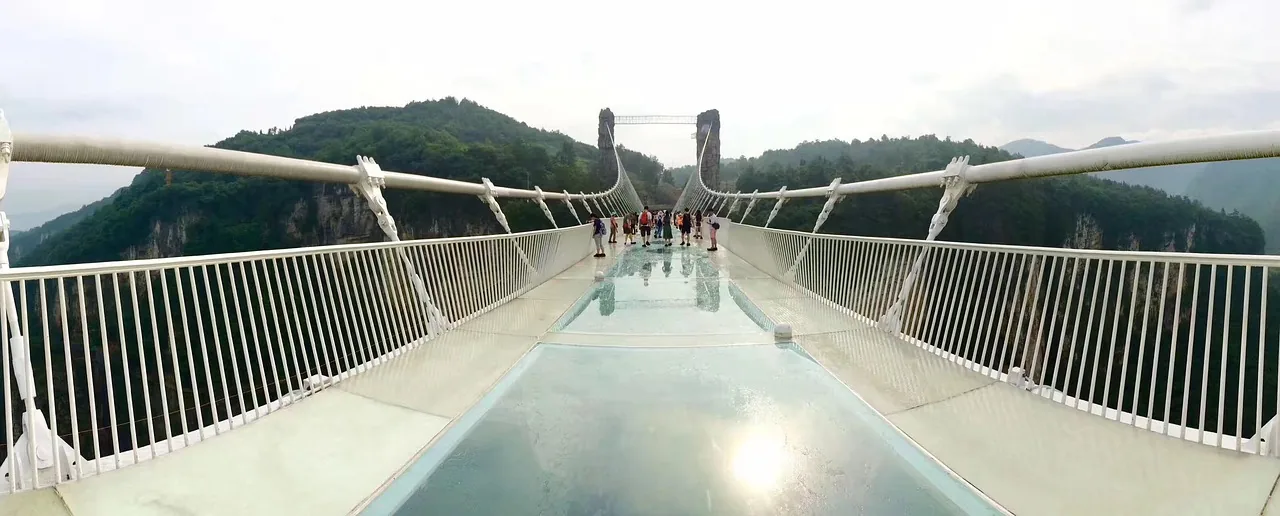
The bridge nearly everyone means is the Zhangjiajie Glass Bridge, which opened on 20 August 2016 in the northwestern part of Hunan province. It is the most famous glass bridge in the world and still one of the highest, hanging 300 meters above the canyon floor. It is not the longest, and it has not been since 2017, whatever the older guidebooks say.
One detail trips up a lot of visitors: the bridge is not inside Zhangjiajie National Forest Park, the park with the sandstone pillars that inspired the landscapes in Avatar. It spans the Zhangjiajie Grand Canyon, a separate scenic area in Cili County with its own ticket and its own gate, about 40 minutes’ drive from the forest park’s east entrance. People book a forest park day and expect to walk the bridge on the same ticket. They cannot.
How many glass bridges are in China?
China built the glass bridge craze and then kept building. Seven are worth naming.
1. The Zhangjiajie Glass Bridge
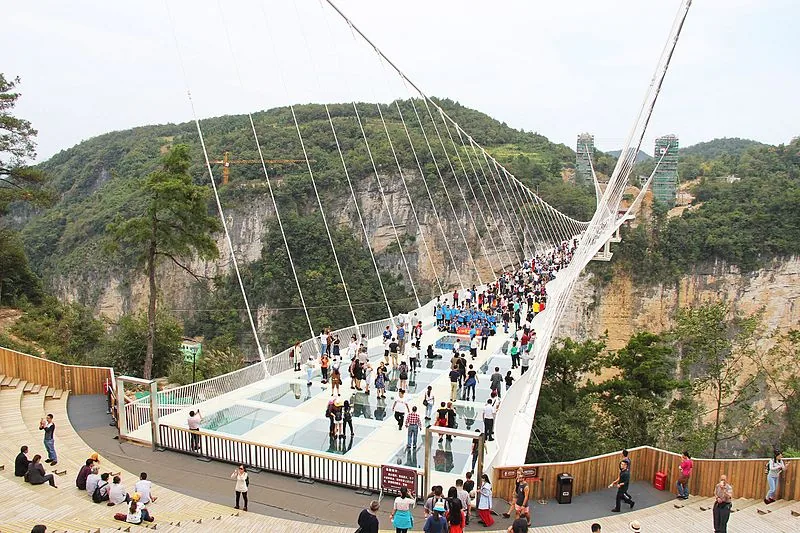
At 430 meters long and 300 meters above the floor of the Zhangjiajie Grand Canyon, this is the one on every postcard. The architect was Haim Dotan. The bridge is six meters wide, carried on a steel frame with four main pillars on each side of the canyon, and its walkway is built from 120 panels of tempered glass, two inches thick, set in three layers.
The management team has never been shy about proving the point. Before opening they invited guests to swing sledgehammers at the panels and drove a loaded car across the deck. Visitors wear protective shoe covers and are told not to run, jump, or lean on the railings. There is a bungee platform at the center of the span, roughly 260 meters above the ground, operated separately from the bridge ticket.
2. The Huangchuan Three Gorges Bridge in Guangdong
This is the one that actually holds the length record in China, and almost nobody outside the country has heard of it. The Huangchuan Three Gorges bridge stretches 526.14 meters across the gorge at Lianzhou, in Qingyuan, Guangdong, hanging 201 meters above the water. It opened in 2020 and Guinness World Records certified it as the longest glass-bottomed bridge in the world. The deck is three layers of tempered laminated glass, 4.5 centimeters thick, rated for about 500 people at once. The designers were the Architectural Design and Research Institute of Zhejiang University.
The world record has since left China entirely: Vietnam’s Bach Long bridge, 632 meters across a gorge in Moc Chau, took the title in April 2022.
3. The Pingjiang Shiniuzhai Bridge in Hunan
The original crossing here was a wooden footbridge for hikers. A 10-meter glass section was let into the deck in 2014, the whole deck went glass in 2015, and Shiniuzhai became China’s first all-glass footbridge. It runs close to 300 meters and hovers about 180 meters above the ground, linking two steep canyon walls in Hunan province. Locals call it the Brave Man’s Bridge, and enough visitors turn back at the entrance to justify the name. A cliff-side walkway leads to one end, a glass elevator saves the climb, and both sides have places to eat.
4. The Hongyagu Glass Suspension Bridge
Hongyagu links two peaks in the Hongyagu Scenic Area, Pingshan County, Hebei province. It is 488 meters long, four meters wide, and 218 meters above the ground, and it opened on 24 December 2017, which made it the longest glass bridge in the world for two and a half years. It is built on suspended cables and lined with 1,077 glass panels, each four centimeters thick. It is rated for 3,000 people but capped at 600 at a time, and it is designed to sway underfoot on purpose.
It has a closure in its history. In 2019 Hebei province shut all 32 of its glass attractions, Hongyagu included, pending safety reviews. It came back: Chinese reporting from 2024 describes the bridge as open and busy with young visitors, and the scenic area lists year-round hours. Provincial safety reviews have closed these structures at short notice before, so a quick check is still worth the minute it costs.
5. The Yunyang Longgang Glass Bridge
Yunyang Longgang is not a bridge across anything, and that is the thrill of it. The walkway, known in Chinese as the Yunduan Langqiao (roughly “corridor bridge in the clouds”), runs out from the cliff in the shape of a flower’s petals and simply stops in open air, 26.68 meters clear of the rock face. It sits on a cliff 1,010.5 meters above sea level, with a vertical drop of more than 700 meters beneath the glass floor and nothing but glass in the railings. That projection is longer than the Grand Canyon Skywalk in Arizona, which puts it among the longest cantilevered glass skywalks in the world. It was completed in 2015 at the rim of the Longgang sinkhole, in Yunyang County at the center of the Three Gorges Reservoir area in Chongqing. Expect to queue for it at busy times.
Getting to YunyangYunyang Longgang sits in the Three Gorges end of Chongqing municipality, several hours from the city itself, so most visitors sleep in Chongqing and treat the geopark as a day out. A private Chongqing tour covers the urban half of the trip, the hot pot and the Yangtze and the Hongya Cave district, without you negotiating a long-distance bus timetable in Mandarin.
6. The 3D Glass Bridge at Shapotou in Ningxia
This one began as a practical fix. A wooden suspension bridge was thrown across the Yellow River at Shapotou, in Zhongwei, Ningxia, in 2004, 2.5 meters wide and 329 meters long. In 2017 the wooden panels came out and glass went in, 10 meters above the water. Two 60-meter sections are clear tempered glass, and two 75-meter sections carry 3D scenes painted into the layers. The paintings put a waterfall, a steep drop, or a dark canyon under your feet where there is only the Yellow River, which is unsettling enough that some people finish the crossing along the handrail.
7. The Suspension Glass Bridge in Guangxi
The hardest of these to reach sits at the Shuanglonggou primeval forest resort in Guangxi, on the main crossing path over Shuanglong Ditch. It runs 199.9 meters over a valley 52 meters deep. It has a reputation as the prettiest glass bridge in China, and the resort has leaned into that, hosting group yoga sessions strung out along the span and a steady traffic of marriage proposals.
How to get to the Zhangjiajie glass bridge
Zhangjiajie Grand Canyon is about 62 km from Zhangjiajie city, which is 80 minutes or so by road, and about 40 minutes from Wulingyuan and the forest park’s east gate. The cheap way is the bus from Zhangjiajie Central Bus Station for around CNY 22, though the bus usually means a transfer and closer to two hours door to door. A taxi runs CNY 200-230.
Tickets matter more than transport. A combined Grand Canyon and glass bridge ticket is about CNY 178, the canyon alone about CNY 60, and entry is timed and capacity-capped: 800 people on the bridge at once, 8,000 a day. Book a few days ahead in normal season and further out in summer and around the national holidays, or you will arrive to a sold-out gate. Prices shift, so treat these as a guide rather than a quote.
Give the canyon itself more than the bridge deserves on its own. The walk down through the gorge, the boat on the lake at the bottom, and the slide back up are the better part of the day, and the bridge is a 10-minute crossing that people queue an hour for.
Before you go
Glass bridges are one of the few Chinese attractions that deliver exactly what the photographs promise. Two things will save you a wasted trip: book timed tickets in advance, and check that the bridge you have picked is actually open, because provincial safety reviews have closed these structures before and will again.
Quick answers.
Where is the glass bridge in China?
How many glass bridges are in China?
Is the Zhangjiajie Glass Bridge the longest in the world?
Who built the Zhangjiajie Glass Bridge?
Your dates. My quote.
Twelve hours.
Send your cities, dates and product list. You'll get a fixed written quote, no obligation, no deposit to ask.
superinterpreter · selina@mychinainterpreter.com · Xiamen, China · UTC+8