11 Best Things to Do in Xi'an, China
The Terracotta Army comes first, but the city that unified China has a week of material. Here are the 11 things to do in Xi'an worth your time, with 2026 prices and how to book them.
 Selina Chen 陈丽明 EN ⇄ 中文 · Travel guide
Xi’an was Chang’an, capital of the Qin, Han and Tang, and the eastern end of the Silk Road. Most of the best things to do in Xi’an, or Xian, as many signs and booking sites spell it, come from that history: buried armies, Tang pagodas, a complete Ming city wall. The rest is food. Below are the 11 that earn a place on a first trip, followed by how to get in, get around and fit it into three days.
Two rules apply to almost everything here. Tickets are sold in advance under your real name, so book with your passport details. And bring the physical passport, because that is what the gates check.
1. See the Terracotta Army
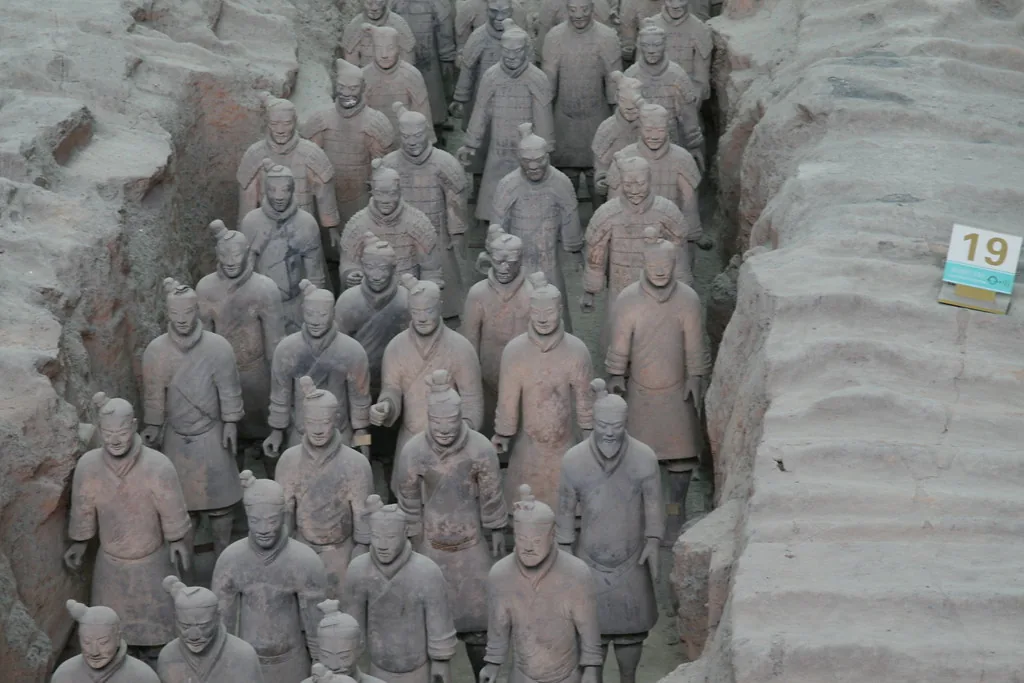
The Terracotta Warriors were buried to guard the tomb of Qin Shi Huang, the king of Qin who unified China in 221 BC and made himself its first emperor. Thousands of life-size soldiers stand in Pit 1, each face modeled differently; Pit 2 holds archers, cavalry and chariots, and Pit 3 is the command post. The Bronze Chariot hall is easy to skip and should not be.
The ticket covers the museum (all three pits plus the bronze chariots) and Lishan Garden, the emperor’s actual burial mound 1.5 km away, linked by a free shuttle. It costs 120 yuan from March 1 to November 30 and 100 yuan from December to February. Booking is real-name: reservations open seven days ahead through the museum’s WeChat mini program (秦始皇帝陵博物院) or the big travel platforms, and summer weekends and the October Golden Week sell out.
The site is in Lintong, about 40 km east of the center. Metro Line 9 runs to Huaqingchi station, a short bus or taxi ride from the museum, or take Tourist Line 5 (游5) from Xi’an Railway Station. Give it half a day at minimum. Go early, start with Pit 1 before the tour groups, and hire a guide if you want the stories rather than the placards.
2. Ride a bike on the city wall
The Ming dynasty wall is one of the best preserved city walls in China: about 13.7 km around, 12 m high and wide enough on top for bikes to pass two abreast. Entry is 54 yuan. Bikes rent on top of the wall for 45 yuan for a single, helmet included, and you can return them at any of the rental points around the circuit.
A full lap takes about one and a half to two hours at an easy pace. Ride it in the late afternoon and finish at the South Gate (Yongning Gate) as the lanterns come on.
3. Climb Mount Hua (Huashan)
Mount Hua is the western of China’s five sacred mountains and the one with the reputation: sheer granite, stairs cut into cliff faces and the plank walk bolted to the South Peak. The South Peak is the highest at 2,154.9 m. The plank walk is optional, costs extra and is a harness-and-carabiner affair. Nothing else on the mountain requires it.
Logistics are the part people get wrong. High-speed trains from Xi’an North reach Huashan North in about 30 minutes, then a local bus runs to the visitor center. Entry is 180 yuan in peak season (March to November) and 100 yuan in winter, booked in advance by real name and time slot. There are two cable cars: the North Peak line is about 80 yuan one way, the West Peak line about 140. The common plan is up by the North Peak cable car, walk the ridge to the South and West peaks, and down by the West Peak line. That is a full, long day. People who hike up from the bottom start at night to see sunrise from the East Peak.
4. See the calligraphy at the Beilin Museum
The Forest of Stone Steles (Beilin), just inside the south wall, holds more than a thousand years of carved stone, including the Kaicheng Stone Classics and steles in the hands of China’s most copied calligraphers. It is where Chinese calligraphy stops being decoration and starts making sense. It reopened after a renovation in May 2025; tickets are 85 yuan, booked in advance by real name. The lanes outside, Shuyuanmen, are lined with brush, ink and paper shops if you want to try it yourself.
5. Spend a morning at the Shaanxi History Museum
The Shaanxi History Museum is the best single museum in the city and one of the best in China: bronze vessels, Tang gold and silver, the Hejiacun hoard, tri-colored glazed figures, and a sequence that walks you from the Zhou to the Tang so the rest of Xi’an makes sense. General admission is free. Free tickets are released through the museum’s WeChat account up to five days ahead at 5 pm and go fast; bring your passport. The main hall is closed on Mondays except public holidays.
In May 2024 the museum opened a second site, the Qin Han Museum, in the Xixian New Area between the city and the airport. It covers the Qin and Han periods in more depth and is far less crowded. If you are flying out in the afternoon, it is on the way.
6. Walk the Big Wild Goose Pagoda and its fountain
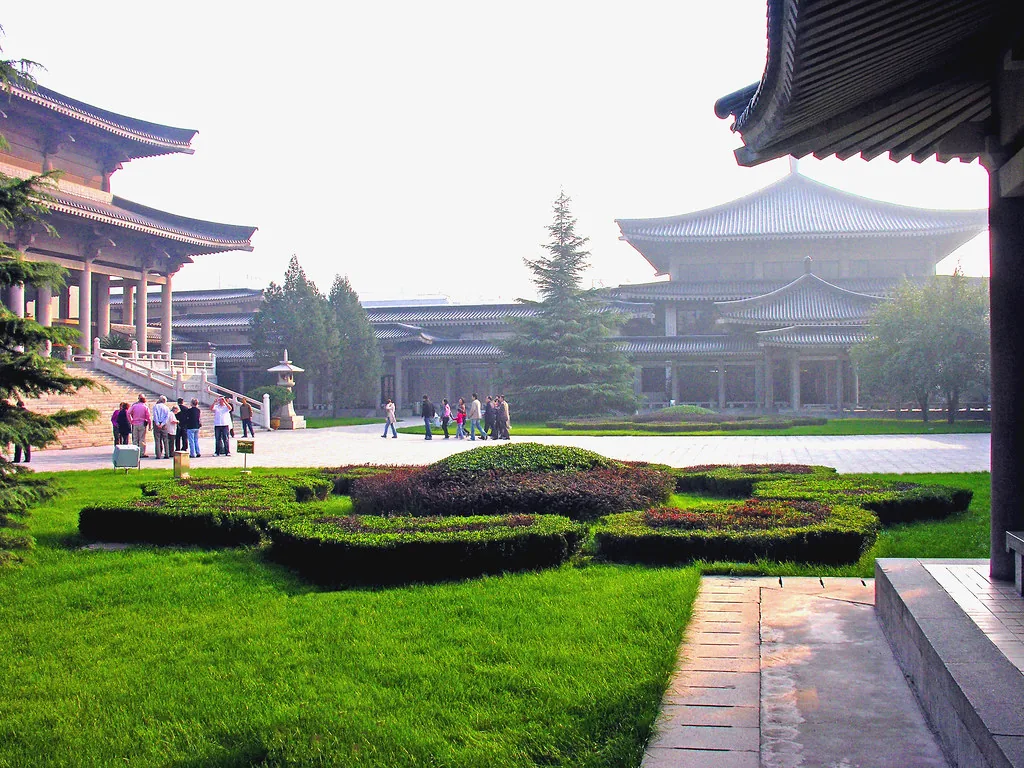
The Big Wild Goose Pagoda was built in the Tang to hold the Buddhist scriptures the monk Xuanzang brought back from India. It stands in the Da Ci’en Temple; temple entry is 50 yuan and climbing the pagoda is a separate 30 yuan. Metro Lines 3 and 4 stop at Dayanta station.
The north square holds a music fountain. Shows run at 12:00, 16:00, 19:00 and 21:00, about 25 minutes each. The 21:00 show is the one to see, with lights. Then walk south.
7. Walk Datang Everbright City at night
Datang Everbright City (Datang Buyecheng) is the pedestrian boulevard that runs south from the Big Wild Goose Pagoda: a long stretch of floodlit Tang-style buildings, street performers, costumed parades and people in rented hanfu taking photos of each other. It is free, it is crowded, and it is best after dark. Treat it as the second half of the fountain evening.
8. Eat your way through the Muslim Quarter
The Muslim Quarter behind the Drum Tower has been home to Xi’an’s Hui community for centuries, and it is where the city’s street food lives. Beiyuanmen is the main drag and the most touristed; the side lanes such as Sajinqiao are where locals actually eat. What to order:
- Roujiamo: chopped stewed meat (beef or lamb here) in a griddled flatbread. Xi’an’s signature snack.
- Yangrou paomo: you tear flatbread into small pieces yourself, and the kitchen ladles lamb soup over it. The smaller the pieces, the better it soaks.
- Biangbiang noodles: belt-wide hand-pulled noodles with chili oil, named for a character with more strokes than most people can write.
- Liangpi: cold, slippery wheat noodles with chili, vinegar and sesame.
- Persimmon cakes (shizi bing) fried to order, and sour plum drink (suanmeitang) to cut the oil.
The Great Mosque on Huajue Lane is a few minutes’ walk in. It is a working mosque built as Chinese courtyards and pavilions rather than domes and minarets, and a quieter half hour than anything else in the quarter. Dress modestly.
9. See the Bell and Drum Towers lit up
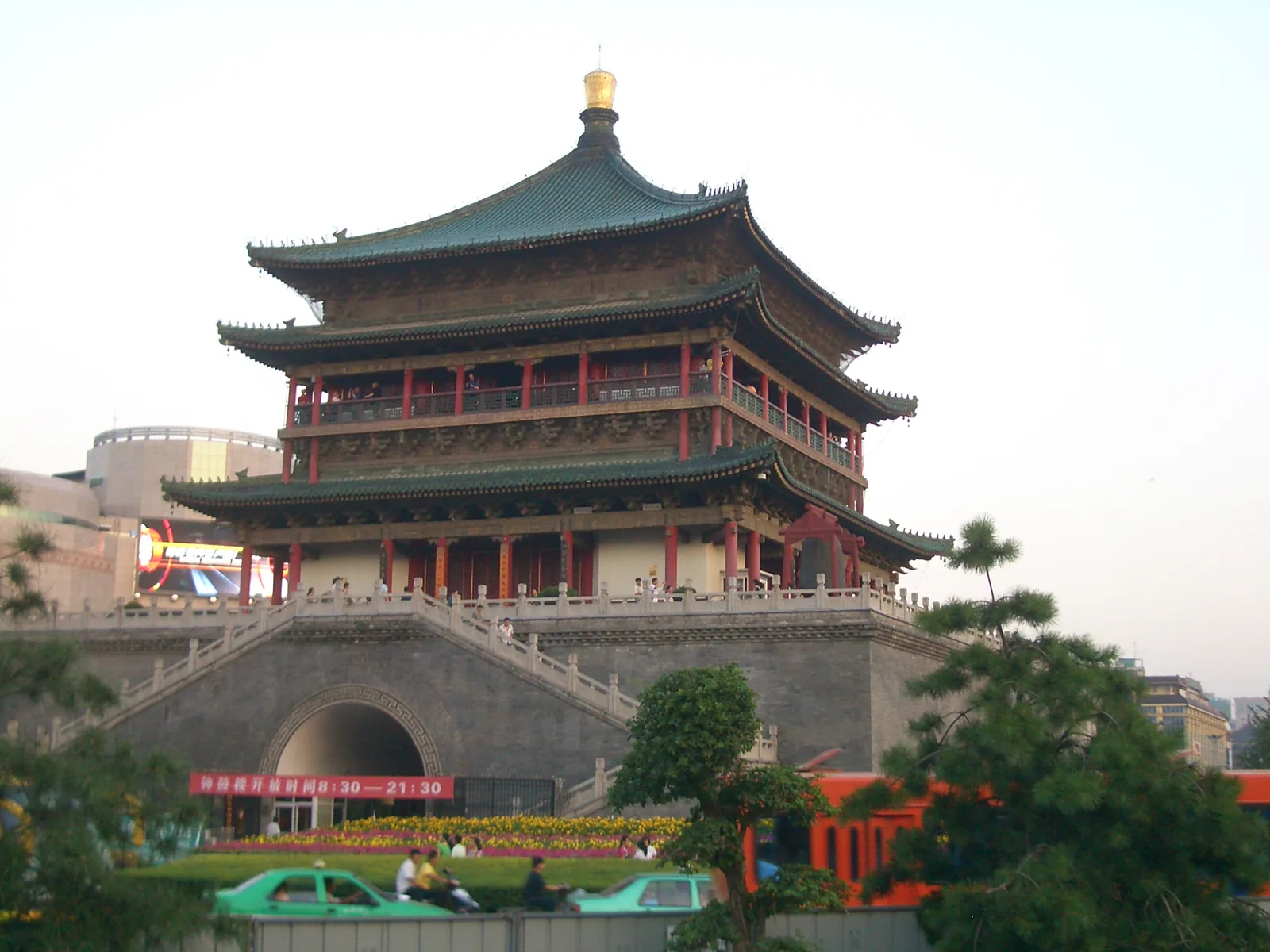
The Bell Tower marks the dead center of the walled city, where the four main streets meet, and the Drum Tower stands just west of it at the mouth of the Muslim Quarter. Both are Ming. Each charges 30 yuan to go up. Both are at their best after sundown, when they are floodlit. The underground passage from Bell Tower metro station (Line 2) gets you to the Bell Tower without crossing the traffic.
10. Visit Huaqing Palace and the Everlasting Regret show
Huaqing Palace is the Tang hot-spring retreat at the foot of Mount Li, where Emperor Xuanzong and Yang Guifei spent their winters, and where Chiang Kai-shek was detained in the 1936 Xi’an Incident. It sits on the way to the Terracotta Army (Line 9, Huaqingchi station), which makes it the natural afternoon add-on.
In the evening the lake becomes the stage for The Song of Everlasting Regret (Chang Hen Ge), a 70-minute outdoor dance drama retelling that love story with the mountain as backdrop. Tickets run roughly 268 to 988 yuan by seating zone and are separate from palace entry: a show ticket does not get you into the palace grounds, and you do not need a palace ticket to see the show.
11. Eat a day out at Yuanjia Village
Yuanjia Village in Liquan County, about 60 km northwest of Xi’an and an hour by car, is a small village rebuilt into a Guanzhong food street: stone-milled flour, vinegar, tofu, chili oil and noodles all made in front of you. It is staged, and it does not pretend otherwise, but the food is the point and it is very good. Go on a weekday. On weekends it is packed with day-trippers from the city.
How to get to Xi’an
By train. Most visitors arrive at Xi’an North, the high-speed station. The fastest trains from Beijing West take a little over four hours; from Shanghai Hongqiao, about seven. Xi’an Railway Station, just outside the north wall, handles slower trains and is the stop for Tourist Line 5 to the Terracotta Army.
By air. Xi’an Xianyang International Airport (XIY) is about 47 km northwest of the center. Metro Line 14 runs from Airport West station, a short walk from the terminals, to Xi’an North in about 33 minutes, where you change to Line 2 or Line 4 for the center. A taxi to the walled city takes about an hour.
Getting around Xi’an
The metro covers nearly everything on this list: Line 2 runs north-south through the Bell Tower, Lines 3 and 4 reach the Big Wild Goose Pagoda, Line 9 runs east to Lintong and Huaqing Palace, and Line 14 serves the airport. Within the wall, walking and bikes are faster than taxis. Ride-hailing through Didi works with a foreign card and is cheap for the gaps the metro does not cover.
Where to stay in Xi’an
- Inside the wall, near the Bell Tower. The default for a first trip. The towers, Muslim Quarter, Beilin and city wall are all walkable, and Line 2 runs through.
- Qujiang, around the Big Wild Goose Pagoda. Newer hotels, a quieter area, and on the doorstep of the fountain and Datang Everbright City. Two metro stops to the center.
- Near Xi’an North. Only if you are catching an early train, including the one to Mount Hua.
When to visit Xi’an
April to May and September to October are the best months: mild, mostly dry, and good for the wall and Mount Hua. July and August are hot and the Terracotta Army sells out. Winter is cold and sometimes smoggy, but ticket prices drop and the sites are quieter. Avoid the October 1 to 7 Golden Week and the May Day holiday if you can, when the big sites sell out days ahead.
How to fit these things to do in Xi’an into three days
- Day 1: Terracotta Army in the morning, Huaqing Palace in the afternoon, the Everlasting Regret show in the evening.
- Day 2: Shaanxi History Museum (book five days out), Big Wild Goose Pagoda, the 21:00 fountain, then Datang Everbright City.
- Day 3: City wall by bike in the morning, Beilin Museum, the Bell and Drum Towers, and dinner in the Muslim Quarter.
Add a fourth day for Mount Hua, and a fifth if you want Yuanjia Village. Three days covers the city. It does not cover the mountain.
Your dates. My quote.
Twelve hours.
Send your cities, dates and product list. You'll get a fixed written quote, no obligation, no deposit to ask.
superinterpreter · selina@mychinainterpreter.com · Xiamen, China · UTC+8