The 8 Most Famous Mountains in China Worth Visiting
From Yellow Mountain to Jade Dragon Snow Mountain, here are eight of the most famous mountains in China, each with its own scenery, history, best time to visit, and the number of days it deserves.
 Selina Chen 陈丽明 EN ⇄ 中文 · Travel guide
 China does not do modest mountains. It does sacred ones. Three of the peaks below (Tai, Hua, and Song) belong to the Five Great Mountains of Taoism, the Wuyue, that emperors climbed for two thousand years to make sacrifices to heaven. One more, Emei, is among the Four Sacred Buddhist Mountains, and Wudang is the Taoist center that gave the world tai chi. The other three earned their fame the honest way: sheer granite, glaciers, and waterfalls.
This article covers eight of the most famous mountains in China worth exploring during a tour of China. For each one you get the same practical shortlist a guide would give you on the drive over: where it is, when to go, how many days it deserves, and what you actually walk up it to see. Each peak has its own specialty, so read to the one that matches the trip you are planning.
#1: Yellow Mountain
Also called Mount Huangshan, this is the peak Chinese landscape painters have been arguing with for a thousand years, and losing to. It sits in southern Anhui Province, its highest point, Lotus Peak, at about 1,864 metres. If you have seen one photograph of a Chinese mountain, a granite spire rising out of a white sea of cloud with a lone twisted pine clinging to it, you have seen Huangshan.
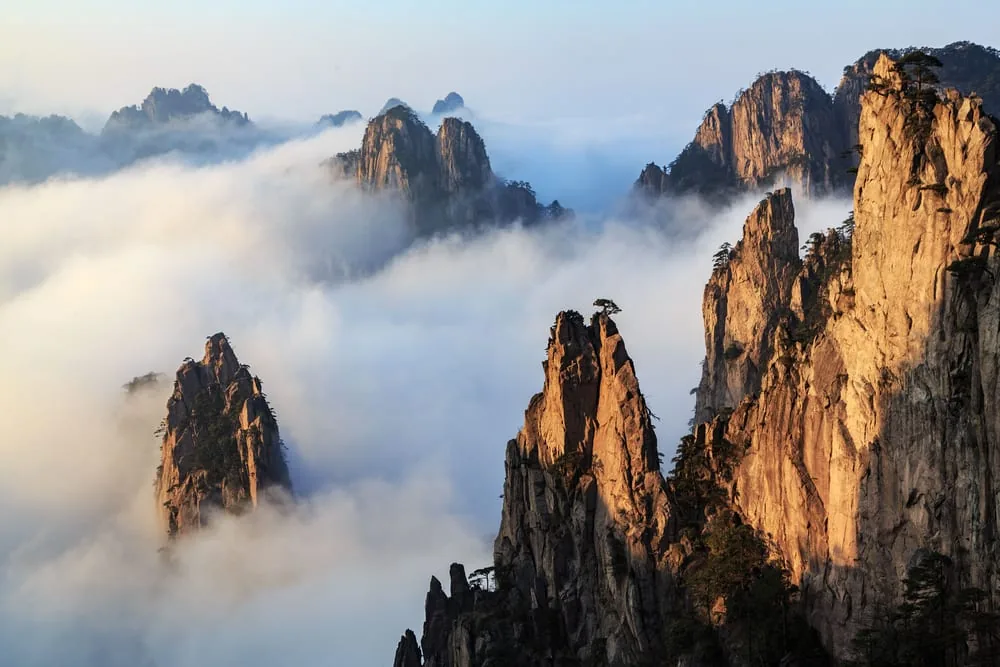
- The granite peaks: eroded into odd, named shapes that people insist look like animals or figures. The trick is the angle, and there is always a better one a few steps on.
- The sea of clouds: low cloud pools in the valleys and leaves the summits floating above it. This is the shot everyone comes for, and it is a matter of luck and early starts.
- The hot springs: at the foot of the mountain, tied by legend to the Yellow Emperor, one of China’s earliest mythical rulers. Treat the story as story.
- The pines: the Huangshan pine grows straight out of bare rock, some jutting from cliff faces, and several individual trees are famous enough to have names.
Location: southern Anhui Province, near Huangshan City.
Best time to visit: March through November. Spring and autumn give the clearest air and the reliable cloud seas. Winter turns it into a snow scene that many hikers rate the best of all, but the West Sea Grand Canyon and some cable cars close from early December to mid March, so check before you commit to a winter trip.
How long to spend: two days. Almost nobody does Huangshan well as a day trip. The move is to go up, stay a night in one of the summit hotels, and be standing at an east-facing viewpoint before dawn for the sunrise. One day up and down is possible and rushed.
What to see: the Bright Summit and Lotus Peak viewpoints, the West Sea Grand Canyon walk, and whichever named pine and rock formations fall on your route. The three cable cars save the worst of the climbing for people who would rather spend their legs on the ridge trails than the approach.
#2: Mount Song
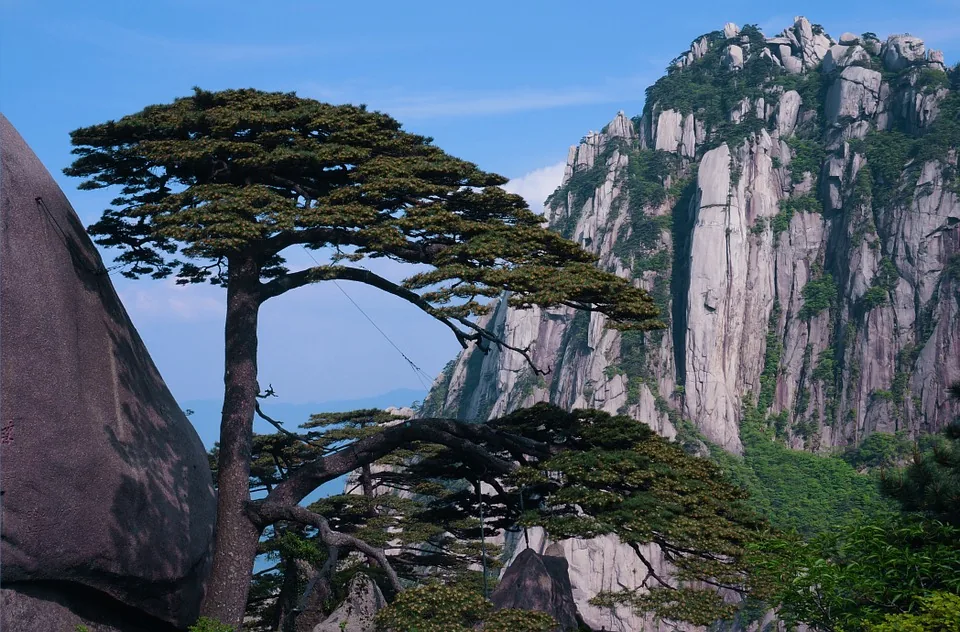
Mount Song is the central peak of the Five Great Mountains, and its main summit, Junji Peak, stands at about 1,492 metres. Most people do not come for the summit. They come for what sits on its slopes. This is where Chan Buddhism, which the world knows by its Japanese name Zen, took root in China, and it is the home of the Shaolin Temple, where Shaolin kung fu was born. If you want the martial-arts pilgrimage, this is the address.
- Shaolin Temple, the working monastery and the source of the legend, with daily demonstrations from the resident monks.
- The Pagoda Forest, the largest cluster of tomb pagodas in China, more than two hundred of them raised over seven dynasties.
- Songyue Temple Pagoda, one of the oldest surviving brick pagodas in the country.
- The Gaocheng observatory, one of the oldest astronomical platforms in China.
Location: Dengfeng, near Zhengzhou, in Henan Province, about two hours from the city.
Best time to visit: spring or autumn, when the weather is mild and the crowds at the temple are thinner than in the summer holidays.
How long to spend: one to two days. A single full day covers the temple, the Pagoda Forest, and a martial-arts demonstration. Add a second day if you want to walk the ridges above Dengfeng rather than only the monastery.
What to see: the temple and Pagoda Forest are the fixed points. Beyond them, the two halves of the range, Taishi and Shaoshi, give you the hiking, and the cable car up Shaoshi saves the legs for the top.
#3: Mount Hua
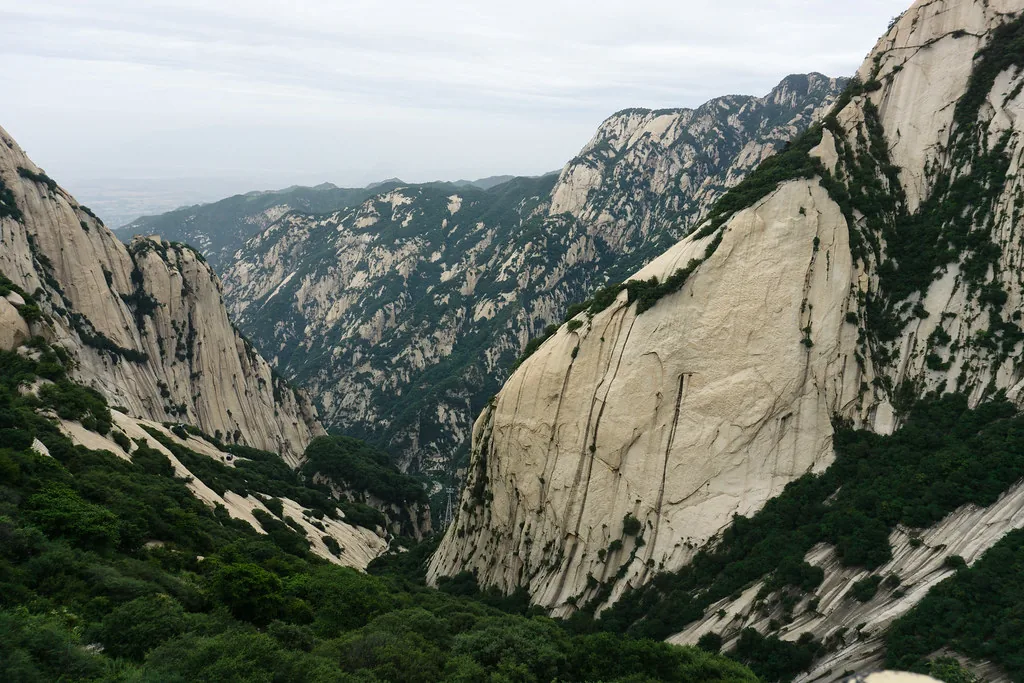
Mount Hua, or Huashan, is the western peak of the Five Great Mountains, and the one people climb to frighten themselves. Its South Peak tops out at about 2,155 metres, and its fame rests on the plank walk: a line of wooden boards bolted to a sheer cliff face, walked in a harness, reputed to be one of the most dangerous trails in the world. The plank walk has real restrictions on age and height and runs in small groups, so it is not a walk-up.
- East Peak: the sunrise viewpoint, worth the pre-dawn climb.
- South Peak: the highest of the five, and where the plank walk begins.
- West Peak: home to the giant lotus-shaped rock the mountain is named for.
- North Peak: the lowest, reached first by cable car, with the classic cloud views.
Location: Huayin, in Shaanxi Province, about 120 km east of Xi’an.
Best time to visit: April through October, with May, June, and September the pick. Skip weekends and national holidays if you can, because the queues on the narrow sections back up badly.
How long to spend: one day is enough, and Huashan makes it easy. A high-speed train from Xi’an North reaches Huashan North in about thirty minutes, so plenty of people climb it as a day trip out of Xi’an. Serious hikers who want to walk up overnight for the East Peak sunrise give it two.
What to see: the five peaks, linked by ridge paths, plus the plank walk for those who book it and clear the restrictions. Two cable cars, one to the North Peak and one to the West, cut out the long haul up so you can spend the day on the ridges.
#4: Mount Tai
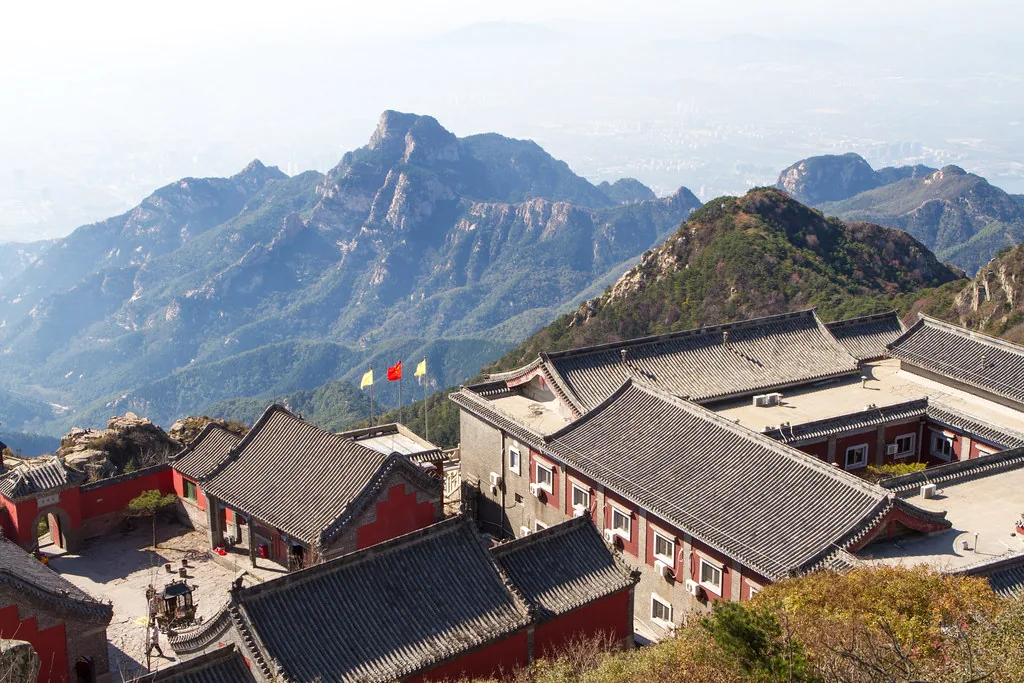
Mount Tai, or Taishan, is the eastern and first-ranked of the Five Great Mountains, and it carries more history than height. Its Jade Emperor Peak reaches about 1,545 metres, which is modest, but emperors climbed it for over two thousand years to perform the fengshan sacrifices to heaven and earth, and it has been a UNESCO World Heritage Site since 1987. You walk up it on stone, not on a path: the classic East Route runs roughly 7,200 carved steps, the same steps the emperors took.
Ancient temples and hundreds of stone inscriptions line the ascent. Jade Emperor Peak and Bixia Temple are the two you do not skip. The peak is famous for its sunrise over the sea of clouds; Bixia Temple is dedicated to a Taoist goddess whom pilgrims still climb to petition.
Location: central Shandong Province, above the city of Tai’an.
Best time to visit: May through November, with September to early November the best window for clear sunrises and comfortable climbing weather.
How long to spend: one day covers it if you take the bus and cable car partway. To do it properly, start in the afternoon, climb into the evening, sleep near the summit, and be on the terrace for sunrise. That is the version people remember.
What to see: the 7,200-step East Route and the temples strung along it, the summit sunrise, and Bixia Temple near the top. If the full climb is too much, a bus to Zhongtianmen and a cable car from there put you close to the summit for the cost of your knees.
#5: Mount Lu
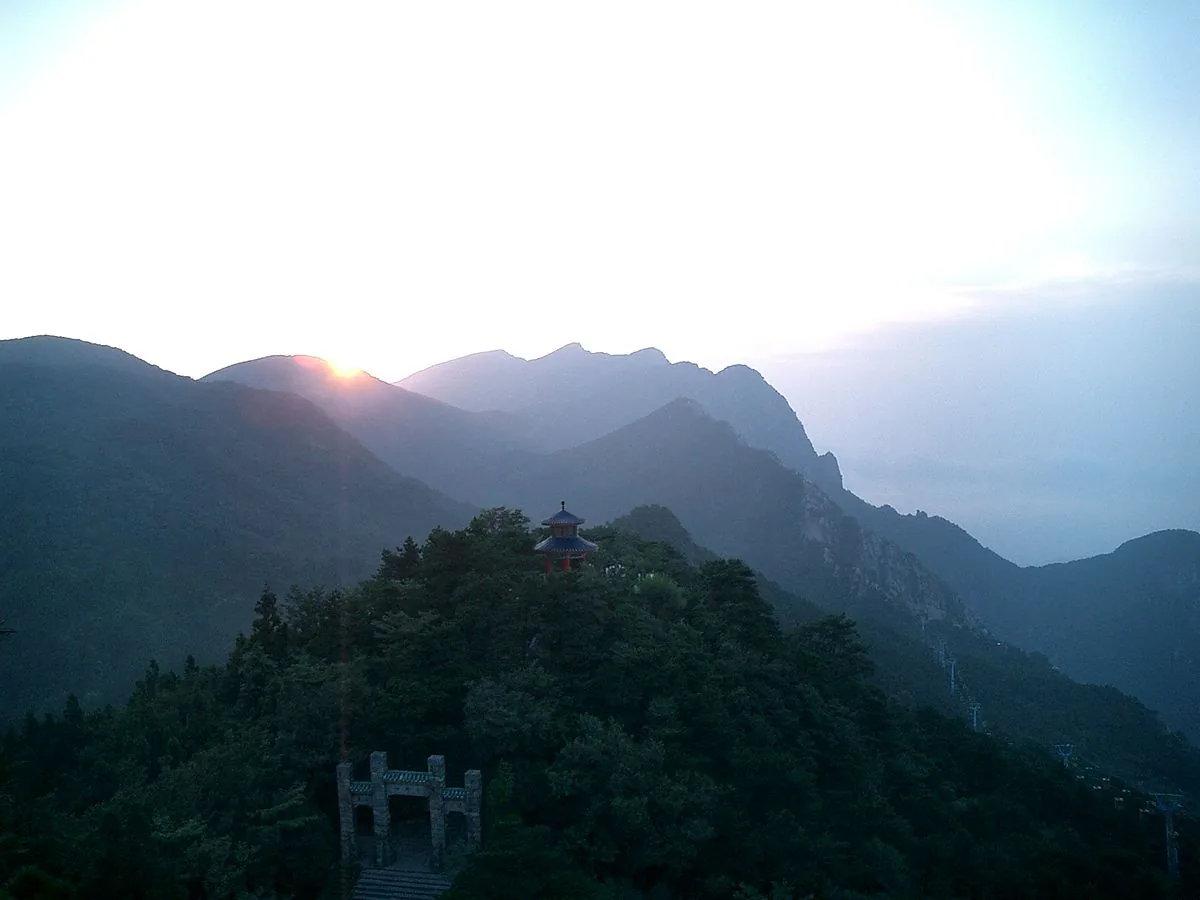
Mount Lu, or Lushan, is the gentle one on this list, and it knows it. Its main summit, Hanyang Peak, reaches about 1,474 metres, and the range has been a UNESCO World Heritage Site since 1996. Where the others test your legs, Lushan was built to be lived on. Near the top sits Guling, a small town of colonial-era stone villas that has served as China’s summer retreat since the nineteenth century, cooler than the plains below when the Yangtze valley bakes.
Its natural draw is water. The Three-Tier Spring waterfall drops roughly 155 metres over three ledges of rock and is the walk most first-time visitors point themselves at. The other thing that sets Lushan apart is its religious mix: Buddhist and Taoist temples share the mountain with old Christian churches left by the foreign residents who summered there, a spread of faiths you rarely find on one peak.
Location: near Jiujiang, in Jiangxi Province.
Best time to visit: May through October. Late spring, around May and June, gives the waterfalls their heaviest flow; autumn gives the clearest long views.
How long to spend: one to two days. A day handles Guling town and the headline waterfall. A second day lets you walk the ridge paths and lakeside trails at the resort’s own unhurried pace.
What to see: the Three-Tier Spring waterfall, Guling town and its stone villas, and the cloud-and-mist views the mountain is named in poetry for. Buses run between the scattered sights up top, which suits a mountain you visit to slow down rather than to conquer.
#6: Jade Dragon Snow Mountain
Jade Dragon Snow Mountain, or Yulong, is the giant of this list and the only one you do not climb. Its highest peak, Shanzidou, reaches 5,596 metres and has never been summited. From a distance the thirteen peaks line up like a dragon lying under snow, which is how it got its name, and the range keeps that snow year-round despite sitting at a low latitude. Geologists call it a natural glacier museum for the variety of glaciers packed onto it.
You do not hike this one so much as ride it. A cable car lifts you to an observation platform at about 4,506 metres for a close look at the glacier, high enough that the altitude is felt. At the foot of the mountain, Blue Moon Valley strings together a series of milky turquoise pools fed by snowmelt, and the Baishui, or White, River runs clear and pale below the peaks. Ganhaizi Meadow, on the eastern side, gives you the wide postcard view of the whole ridge.
Jade Dragon Snow Mountain sits directly above Lijiang, so most travelers see it as one stop on a guided Yunnan tour rather than a trip of its own, paired with the old town below and the towns further north.
Location: about 15 km north of Lijiang old town, in Yunnan Province.
Best time to visit: November through April, when the peaks hold the most snow and the skies over Lijiang stay mild. October can bring fog that hides the summit.
How long to spend: half a day to a full day on the mountain itself, which is why it slots so neatly into a wider Lijiang or Yunnan itinerary rather than standing alone.
What to see: the glacier from the 4,506-metre platform, Blue Moon Valley and its pools, and Ganhaizi Meadow for the full thirteen-peak view. Take the altitude seriously, move slowly up top, and drink more water than you think you need.
#7: Mount Emei
Mount Emei, or Emeishan, is the one you can actually walk to the top of, all 3,099 metres of it, and the highest of the Four Sacred Buddhist Mountains of China. It rises out of the Sichuan basin near Leshan and has been a UNESCO World Heritage Site since 1996, listed jointly with the giant Leshan Buddha carved into the cliff nearby. Around thirty temples are scattered up its forested slopes, and the trails come with a local hazard the others do not: bands of wild macaques that have learned tourists carry food.
The prize is the Golden Summit at about 3,079 metres, crowned by a 48-metre gilded statue of the bodhisattva Samantabhadra. On a clear morning it delivers the four sights the mountain is famous for: the sea of clouds, the sunrise, the colored halo the Chinese call Buddha’s rays, and the flickering saint lamps at night.
Location: near Leshan, in Sichuan Province.
Best time to visit: April through October. Spring brings the azaleas, and the shoulder months keep the summit clear of the worst summer haze.
How long to spend: two to three days if you climb from Baoguo Temple at the base, and you sleep on the mountain to catch the summit sunrise. Bus and cable car can get a determined visitor from gate to Golden Summit in a single long day.
What to see: the Golden Summit and its statue, the older temples like Baoguo and Wannian, and the monkey-lined stretches of trail. Buses run up to Leidongping and a cable car covers the last climb, so you can trade the multi-day hike for a day if time is short.
#8: Wudang Mountains
The Wudang Mountains, or Wudangshan, are the Taoist counterweight to Shaolin. Where Mount Song gave the world Shaolin kung fu, Wudang gave it tai chi. The range sits in Hubei Province, its Golden Peak reaching about 1,612 metres, and its cluster of Taoist temples and monasteries has been a UNESCO World Heritage Site since 1994. Fifty-odd ancient buildings survive, including the stone-walled hall on the summit and the Purple Cloud Temple lower down.
This is a working spiritual center, not a museum. Wudang is the cradle of its own family of internal martial arts, tai chi among them, which legend credits to the hermit sage Zhang Sanfeng, and you will see students training on the terraces. Climb to the Golden Peak for the temple perched at the top and the views back over the ridges.
Location: near Shiyan, in Hubei Province.
Best time to visit: spring through autumn, when the weather is mild and the temples are at their most photogenic.
How long to spend: one to two days. A day reaches the Golden Peak and the main temples by bus and cable car. A second day is worth it if you want to walk between the monasteries or sit in on a martial-arts class.
What to see: the Golden Peak temple at the summit, the Purple Cloud Temple, and the martial-arts schools that still train on the mountain. A cable car carries you most of the way up, leaving a short climb to the peak itself.
Conclusion
Eight mountains, and no two ask the same thing of you. Some are day trips off a high-speed train; others want three days and a night on the summit. Some you climb for the sunrise, some for the temples, one you ride a cable car up and never touch the top of. Match the mountain to the trip you are actually taking, not the other way round. These peaks hold far more than we have room for here, but any one of them earns its place on a China itinerary.
Your dates. My quote.
Twelve hours.
Send your cities, dates and product list. You'll get a fixed written quote, no obligation, no deposit to ask.
superinterpreter · selina@mychinainterpreter.com · Xiamen, China · UTC+8